Showing posts with label coast. Show all posts

Saturday, 19 September 2020

Waiting for family, working the bands

Another round of waiting for teenagers to return from some crazy activities somewhere led to a brief opportunity to work 17m from the shore this afternoon.  Weather continues to be amazingly warm and sunny for the time of year, but with a moderate easterly wind that brought out the windsurfers.

I wondered if I could get JTDX to work on the Raspberry Pi 4B, so downloaded it using the mobile wi-fi.  Whilst the version listed for Linux wouldn't work, the version for the Pi 3 did.  

One thing to note if you download JTDX for the Pi is that, once installed, you must reboot to see the program listed under 'Sound and Video'.

 JTDX, up and running on the Pi 4 in the car.

From then on, it was easy going!  No more WSJT-X, which is far less capable than JTDX.  

Very happy to be the only station being heard on 17m WSPR by VU3KAZ (1W out), despite the simplicity of my /P station.  Of course, with the seawater, the effective signal is known to 'grow' to something between 10 and 25W typically. 

Just a shame K2IL started sending FT4 for quite a while, straight on top of ongoing WSPR transmissions.  In fairness, after sending him a polite e-mail, he moved a good distance down in frequency within a minute or two.

Sun, wind and kite surfers (and a weirdo doing something with a big antenna!)

I managed 19 FT8 QSOs using 6-8W, spanning the western US to Brazil and Indonesia.  Again, very pleasing results with such low power.

6-8W FT8 coverage at 18MHz from the beach.


Wednesday, 25 December 2019

Colwyn Bay Seaside /M

More seaside activity, this time from Colwyn Bay sea front, north Wales.

This turned out to be a great place to work short path to the east.  In the case of VK3GMZ, I was the only one outside of Australia to be heard by him on 14MHz WSPR (1W out of my mobile stick):


In the case of VK3KHZ as receiver, I had a median signal to him of -24dB, a full 10dB stronger than the only other UK station being heard (G0CCL, 5W), with few other stations from Europe making it at all:


And finally, in the case of HS0ZKM, I was 4dB stronger than the only other UK station being heard by him:
On my receive, I was blown away by the sheer strength of RX3AFE, whose signal I first thought was a very local one, within a few km of me.  At a peak of +18dB, with multiple spots as a result, this was amongst the strongest WSPR signals I've ever decoded, and up there with the few other similarly strong reports from Europe.  The 14MHz delta loop back home was receiving RX8AFE 6dB weaker than my simple mobile stick!


No matter how many times I operate with this simple equipment, I am always amazed by the outcome.  Remember, this was achieved not out on the sand with a golfing cart, coat and woolly hat, but simply by parking up, sitting comfortably in the warm car on the sea front, about 8 metres from the water.  Station is set up and down in 2 minutes.  Nothing quite brings a smile to my face as coastal /M operating!

Tuesday, 17 December 2019

More amazing WSPRs

I had another session at the beach this morning, sending 1W WSPR to the world from the usual Ampro 14MHz vertical stick antenna.

This time, my signal from the beach was heard by three fairly closely-spaced stations in China, with a best report of -20dB.  I have rarely seen China on my WSPR hit list before.

Only the typically-excellent monopole of G0CCL with a factory as a ground plane was the other European station to be heard there, although I was 10dB stronger, and being heard earlier (normally, G0CCL should be heard earlier due to being further east):


Once again, the signal from my vertical delta was completely unheard by any of the three Chinese stations.  That was also the case for LU1ESY1, who only heard my mobile stick.  Both antennas reached PY2GN, but the stick was 7dB stronger than the delta (-17dB vs. -24dB means):
MW1CFN/M being received (1W)
However, the delta did get a signal to a couple of ZL stations, but so did my stick antenna, albeit a different, SWL receiver.

The following morning, the robustness of the path from the coast, and how few other European stations were crossing it, proved itself again (the delta never got there):

And the following morning to BA7KW and BG8IBS:


Friday, 13 December 2019

Dawn.

This morning, I upset my usual routine and took the mobile station down to the beach.

It was only 07:30UT when I got down there, and still pretty dark, made worse by heavy cloud cover and a 90km/h wind (oh, and by the Conservatives winning the general election overnight!)

At this time of year, at that time of day, and with the solar cycle at rock-bottom, I wasn't expecting an awful lot of success with 'real' QSOs.

But I was wrong!  I was getting strong 14MHz FT8 and FT4 QSOs from my 20W to a Ampro stick antenna with stations in Asiatic Russia right from the start.  These QSOs do not occur until about 90 minutes later when I am at home, using a full-sized delta loop.

Curiously, and perhaps because of the /M extension, PSKreporter was showing only a very small number of spots for my signal, which is a shame.

A very brief session of WSPR then ensued.  The first thing one always notices at the beach when tuning to WSPR is just how piercingly loud many of the received signals are.

Above: a handful of 14MHZ, 1W WSPR transmissions from the beach.
ZL3JE's reception at the time (3 hour span).  Note how small location differences in the UK yield vastly different paths.

ZL3JE was receiving only three stations from the UK at the time.  The table below lets you see how well a stick on top of the car performs at the beach, but in short, I was 5-13dB stronger than the other two stations (note that G0CCL increases to 20W output at 09:08UT).  G0CCL has a vertical monopole with a whole metal sheet factory complex as a ground plane.  MW0ATK has a windom, according to his WSPR page.


What's the point of repeatedly banging on about how good /M or /P operating can be?  Easy: the equipment is cheap, quick to deploy, and very, very effective (a stick antenna down the beach is likely to be as good as, or better than, a 3-ele Yagi at a more inland location).  If you have too much RFI locally, just move somewhere else!  If you have bad neighbours and/or local authorities, forget arguing with them all and go down the local beach or up a hilltop.  It's just so much easier, so less stressful.

Thursday, 19 September 2019

Tidying up at the beach

During the past 24 hours, I decided to gather more WSPR data by comparing identical (elevated, 1/4 wave vertical, 2 radials) antennas, one located at the seaside, the other at home.  Previous work had tended to compare a mobile whip with a delta loop at home, or used more distant stations for comparison, both approaches having advantages and disadvantages.

'Home' means 100 metres up on a ridge overlooking the sea.  In the direction of the eastern seaboard US, the sea is about 12km distant, and visible.  In the direction of the west coast US, the sea is 7km distant, and visible.
West coast Wales, listening to the US.  My old runaround car has hit a fair few boulders in its travels!

Whilst I had been back-calculating to compensate for power output differences between my own station on the beach and my reference inland station, G0CCL, I had to abandon this method.  That was because there is a very clear and consistent disparity between reception reports at 5W, and those at 1W.  That is probably an effect of the ionosphere and/or noise local to the receivers, and not anything to do with G0CCL.

So, the simplest option was to resort to listening instead.  This also removed the 20 minute delay in propagation changes that occur as a result of the longitude difference between me and G0CCL.

The outcome of the evening listening to the US was a +10dB advantage to the sea side.  The range was +14dB to +4.5dB.

To the east, in the morning, there was a +12.5dB advantage to the sea side antenna.  The range here was +19dB to +10dB.
East coast listening in the morning.

In both cases, there were several stations that were not heard at all by the vertical at home.  In the case of JA9TTT, which was heard at -14dB at the seaside, and not at all back home, the inferred signal enhancement there, based on WSJT-X's detection limit being -34dB, might be as high as 20dB.  I've seen up to 29dB enhancements with other stations in earlier work.

So, I've now run out of time and energy for this work, and will soon ruck out of luck with the very fine weather we have had for most of September.

The basic story is that being at the coast, without actually having to be in the water, typically boosts your performance by roughly 10dB, or a ten-fold increase in signal, with a good number of paths showing enhancement of about 14dB (25 times), and occasional ones nearly 30dB (1000 times).


Sunday, 15 September 2019

More data from the beach.

Yesterday was another lovely sunny day, albeit with a steady 30 knot wind blowing from the south.  A good day for more beach WSPR work, using my daughter's callsign.

Dying days of summer.  Rhosneigr beach, Anglesey (IO73rf).  Note 1/4 and 1/2 wave markers in sand!

There are still a fair number of tourists around, who tend to pose occasional problems in terms of managing adult, child and dog safety near the antenna.  Luckily, the stiff wind had kept all but a small number away from the seaside!

The beach I used has a very wide open aspect from SSW to NNW - Rhosneigr Beach, on the west coast of Anglesey.  This is much easier to work from than Newborough, my previous site, as it has a steeper slope, with no need to move the antenna for over two hours.

Operating site.
I started work at low tide, but the water's edge hardly moved during the first two hours, as the water on the incoming tide simply filled a depression in the beach; very useful!  The antenna was at just over 1/2 a wavelength from the water's edge at its furthest point, and 1/4 wavelength as I neared the end of the run.

Now I'll turn some attention to that working distance first.  Just about anybody who writes about working at the seaside will conclude that you have to be within 1/4 of a wavelength to see the enhancement effects of the water.  They claim that useful gain due to the water is lost beyond 1/2 a wavelength.  A lot of the claims are based on American computer modelling, and not on real world operating.  Those models use a flawed version of reality, where there is something called 'sea' that stops at a single, discrete point, and everything beyond that is termed 'land'.

The reality it very different at the beaches I work from: the water's edge may be so-and-so metres away from you, but on a gently sloping sandy beach, the sand remains fully saturated with seawater,which is often a mix of slowly percolating water left behind as the tide goes out, and upward migrating water from the water 'table' just below the surface.  If you cut a hole in the sand, it immediately fills with water all the way to the sandy surface.

So, in my situation, whilst the antenna seemed initially to be physically away from the sea/land interface it was, electrically, still positioned directly over seawater, which also extended to the landward side.  You can actually see this in the photo above, as the large rock embedded in the sand is surrounded with seawater; it's not a pool as such, because the sand is permeable, and the water would otherwise quickly seep out. 

This reasoning, and its expectations, is supported by a couple of plots I prepared for two stations.  You can see that, even though the tide was advancing very slowly towards the antenna, decreasing from just over 1/2 to 1/4 wave with time, there is no evident enhancement due to the water's edge itself getting closer:


As for the results, well, they were very pleasing, with up to +17dB available, over and above G0CCL, a very reliable and efficient station in Cambridgeshire, which alternates between 1 and 5W output, for which allowance is made in the computations:


So, at the highest enhancement level, you could set 1W on your transceiver and enjoy an effective output of 50W.  Now that's worth going down the beach and getting covered in wet, sticky sand!

Very interestingly, when I looked at a couple of German stations lying to landward (east), my beachside location yielded a 26dB enhancement for DL1DAF, and 29.5dB for DF5FH, relative to G0CCL.  I don't know what the actual mechanism for this very large enhancement to the landward side may be.

When I tried to run a comparison with the only other 100mW station I could find (G4SGI) on SOTABeams' DXPlorer site, it was impossible to do, because G4SGI's signal never made it further than 1010 km!  Unfortunately, DXPlorer doesn't currently make automated, output-compensated computations between stations; I've suggested that such a column in their tables should be included.
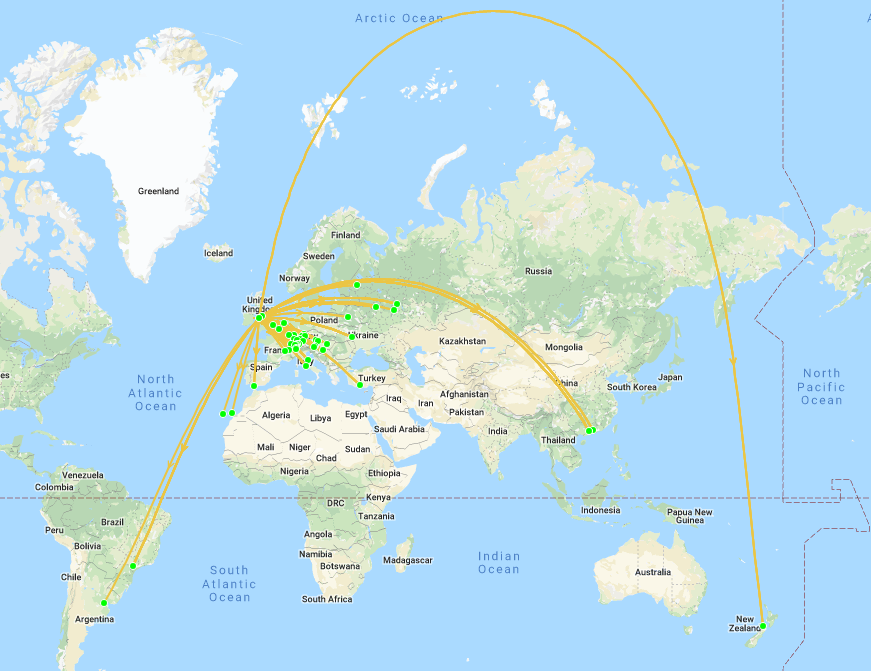
14MHz, 0.1W WSPR coverage over ~2.5 hours from IO73rf.

Thursday, 5 September 2019

As more proof were needed...

This morning, between 08 and 09UT, I visited Red Wharf Bay, which has a wide, open sea horizon to the eastern hemisphere.  Last year, I had great DX results with low power from mobile whip and magnetic loop antennas.

Today, I decided just to listen from the car whilst the delta loop was also listening back home.

At Red Wharf Bay, September 2018, when the tide was at its highest.
Once again, the results are spectacular, and firmly highlight why, if you can, you should get a HF station down to your nearest beach.  The tide need not be in; it was about 2km away from me this morning, although the vast sandy bay was saturated with sea water.

In four out of seven cases, my simple mobile whip for 14MHz, coupled to a TS480SAT and Raspberry Pi 3B+ running WSJT-X, latest edition, could hear stations that my full wave delta, even though it is on elevated and highly mineralised ground and in an open environment, could not hear at all.

MW1CFN/M (beach), where the same stations were not heard at home:

JA9TTT, spots = 4, median S/N= -13dB.  
R2ARX, spots = 3, median S/N= -22dB
OH8GKP, spots = 5, median S/N = -04dB
UB1NDF, spots = 4, median S/N = -24.5dB


Here are the comparisons for those stations that were heard by both antennas, although the beach location produces more spots, and the difference in strengths is fairly small:

RA6AAW, beach spots = 5, median S/N = -2dB, home spots = 1, median S/N = -07dB
UR5KHL, beach spots = 9, median S/N = -20dB, home spots = 3, median S/N = -24dB

Proving that very low angle radiation is important in producing these differences, my delta was hearing the nearby PA1JT stronger than at the beach, although with the same number of spots:

PA1JT, beach spots = 4, median S/N = -3.5dB, home spots  = 4, median S/N = +07dB

It's very satisfying to obtain these results, especially when one recounts the words of the late Les Moxon, G6XN, when he thought (p. 168, HF Antennas for all Locations) about what the seaside could bring - without the benefit of WSPR and other digimodes that make his suggested experiments now, 26 years since his book's second edition, so easy and objective:

"At the Seaside.

...This is a complicated situation which is diffiult to analyse, though it can be assumed that, for some very low angle (possibly well under 1 degree) even the near edge of the [Fresnel] zone will be pushed out to sea.  This suggests dramatic possibilities but (from the lack of published information) either these have not yet been explored or there is a hidden catch somewhere.  It is hoped that readers in suitable locations will be encouraged to experiment on these lines." 

Well, Les, you were right. The effects are, indeed, dramatic!  A quick comparison with G0CCL, putting out 7dB more power than me, yet getting far weaker reports from VE6EGN, suggests a minimum 18dB advantage conferred by being near the sea. Wow!  Take a 10W QRP transceiver, and you could be putting out the equivalent of 640W!