Showing posts with label mobile. Show all posts

Tuesday, 17 December 2019

More amazing WSPRs

I had another session at the beach this morning, sending 1W WSPR to the world from the usual Ampro 14MHz vertical stick antenna.

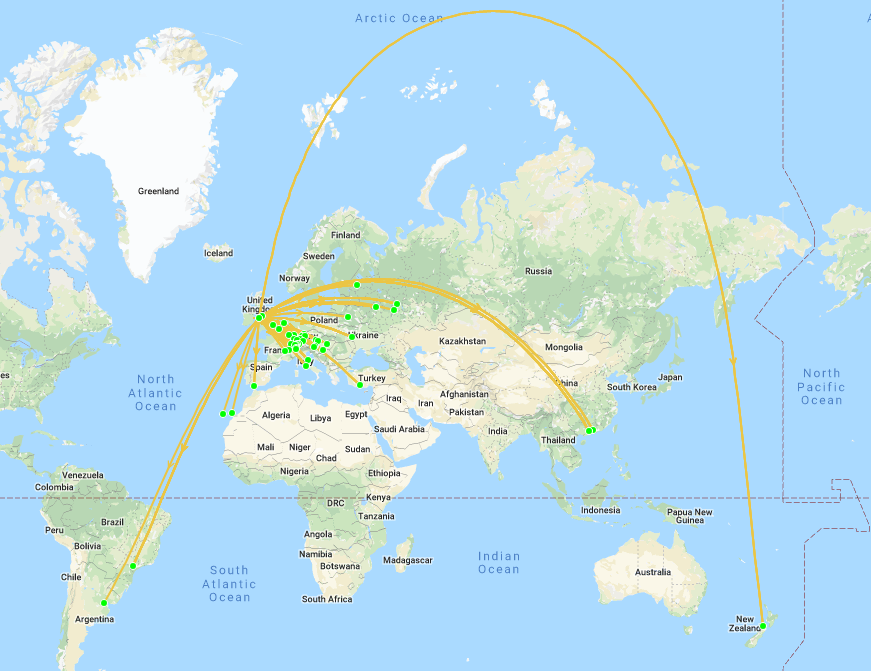
This time, my signal from the beach was heard by three fairly closely-spaced stations in China, with a best report of -20dB.  I have rarely seen China on my WSPR hit list before.

Only the typically-excellent monopole of G0CCL with a factory as a ground plane was the other European station to be heard there, although I was 10dB stronger, and being heard earlier (normally, G0CCL should be heard earlier due to being further east):


Once again, the signal from my vertical delta was completely unheard by any of the three Chinese stations.  That was also the case for LU1ESY1, who only heard my mobile stick.  Both antennas reached PY2GN, but the stick was 7dB stronger than the delta (-17dB vs. -24dB means):
MW1CFN/M being received (1W)
However, the delta did get a signal to a couple of ZL stations, but so did my stick antenna, albeit a different, SWL receiver.

The following morning, the robustness of the path from the coast, and how few other European stations were crossing it, proved itself again (the delta never got there):

And the following morning to BA7KW and BG8IBS:


Thursday, 12 September 2019

An evening's listening.

As ex-tropical storm Gabrielle gave way to clearing skies this evening, I spent an hour (17:52-18:52UT) listening on 14MHz WSPR from the car by the sea.

Once again, the results with a simple, and very cheap whip vertical were excellent.  Of 17, US stations heard regularly, the coastal location yielded a modal enhancement, relative to my full wave 14MHz delta loop, of 7dB, or a power factor of 5.

That sounds quite modest, until you look at the range, which is from 14.5dB to 1dB, or a power factor of between 28 and 1.25 times.  The highest enhancement was to the signals from the best DX stations of AA7FV and K5XL, at 8147 and 7315km, respectively. 

Lovely sunset, and great results!

With the new ICOM portable all-band transceiver now adding to the still fairly limited range of field-portable rigs, this and my other results clearly show the way in getting the very most out of the 10-15W such rigs typically produce at their higher settings.

At 10W into a simple vertical within a few tens of metres of the sea (and not 'feet wet' style, which is probably even better, but a lot less convenient), you could be effectively putting out 280W in the direction of the sea.  Or, looking at it another way, 56W ERP from dialling-in just 2W on your rig!

If you think those claims are somehow special or unachievable in practice, have a look around the internet for those who operate pedestrian mobile by the sea, or listen to how they have 5/9 SSB QSOs with VK and ZL on a few Watts, whilst you can't even hear those stations!


And remember, this was just a one hour test!  The results around greyline time in the morning to the antipodes are certain to be impressive.  One morning, I'll get around to it.  Until then, here's what you can do with half a Watt or less:

Thursday, 5 September 2019

As more proof were needed...

This morning, between 08 and 09UT, I visited Red Wharf Bay, which has a wide, open sea horizon to the eastern hemisphere.  Last year, I had great DX results with low power from mobile whip and magnetic loop antennas.

Today, I decided just to listen from the car whilst the delta loop was also listening back home.

At Red Wharf Bay, September 2018, when the tide was at its highest.
Once again, the results are spectacular, and firmly highlight why, if you can, you should get a HF station down to your nearest beach.  The tide need not be in; it was about 2km away from me this morning, although the vast sandy bay was saturated with sea water.

In four out of seven cases, my simple mobile whip for 14MHz, coupled to a TS480SAT and Raspberry Pi 3B+ running WSJT-X, latest edition, could hear stations that my full wave delta, even though it is on elevated and highly mineralised ground and in an open environment, could not hear at all.

MW1CFN/M (beach), where the same stations were not heard at home:

JA9TTT, spots = 4, median S/N= -13dB.  
R2ARX, spots = 3, median S/N= -22dB
OH8GKP, spots = 5, median S/N = -04dB
UB1NDF, spots = 4, median S/N = -24.5dB


Here are the comparisons for those stations that were heard by both antennas, although the beach location produces more spots, and the difference in strengths is fairly small:

RA6AAW, beach spots = 5, median S/N = -2dB, home spots = 1, median S/N = -07dB
UR5KHL, beach spots = 9, median S/N = -20dB, home spots = 3, median S/N = -24dB

Proving that very low angle radiation is important in producing these differences, my delta was hearing the nearby PA1JT stronger than at the beach, although with the same number of spots:

PA1JT, beach spots = 4, median S/N = -3.5dB, home spots  = 4, median S/N = +07dB

It's very satisfying to obtain these results, especially when one recounts the words of the late Les Moxon, G6XN, when he thought (p. 168, HF Antennas for all Locations) about what the seaside could bring - without the benefit of WSPR and other digimodes that make his suggested experiments now, 26 years since his book's second edition, so easy and objective:

"At the Seaside.

...This is a complicated situation which is diffiult to analyse, though it can be assumed that, for some very low angle (possibly well under 1 degree) even the near edge of the [Fresnel] zone will be pushed out to sea.  This suggests dramatic possibilities but (from the lack of published information) either these have not yet been explored or there is a hidden catch somewhere.  It is hoped that readers in suitable locations will be encouraged to experiment on these lines." 

Well, Les, you were right. The effects are, indeed, dramatic!  A quick comparison with G0CCL, putting out 7dB more power than me, yet getting far weaker reports from VE6EGN, suggests a minimum 18dB advantage conferred by being near the sea. Wow!  Take a 10W QRP transceiver, and you could be putting out the equivalent of 640W!