Monday, 6 May 2013

HF Magnetic Loop - In An Afternoon.

It's been a very long winter and, with the sun finally out and the weather warm, all that pent-up antenna building energy had to come out!

So, on the bank holiday, I decided I would have a go at a magloop for HF.

Magloops seem to have a bit of an air of mystery about them.  This seems to be down to two things - the need for a tuning capacitor of high voltage handling, and the very sharp tuning range.  Neither, in practice, are anything to worry about.

I was sorely tempted to scavenge a capacitor from my ATU, which these days tends to lie rather redundant owing to my improved antenna-building skills.  But I opted first for the drinks-can capacitor system, as it's cheap and is interesting to make.  You can see a fine image of the capacitor courtesy of Alex, PY1AHD below:

Looks unlikely, the cans are a bit weak and unstable, but it does work.

The loop was made to a square profile using 15mm copper tube; shape doesn't seem to make a huge difference, but a square is, some say, somewhat less efficient than a circular profile.  In the International Antenna Collection book, a professor says shape makes very little difference.  A square is infinitely easier to construct, so you may want to weigh up the costs and benefits when wondering whether to roll some copper!  I'm mostly interested in the 20m band, so I built the loop to be about 5m all the way round.  Remember to clean those joints and use flux for a good fix!
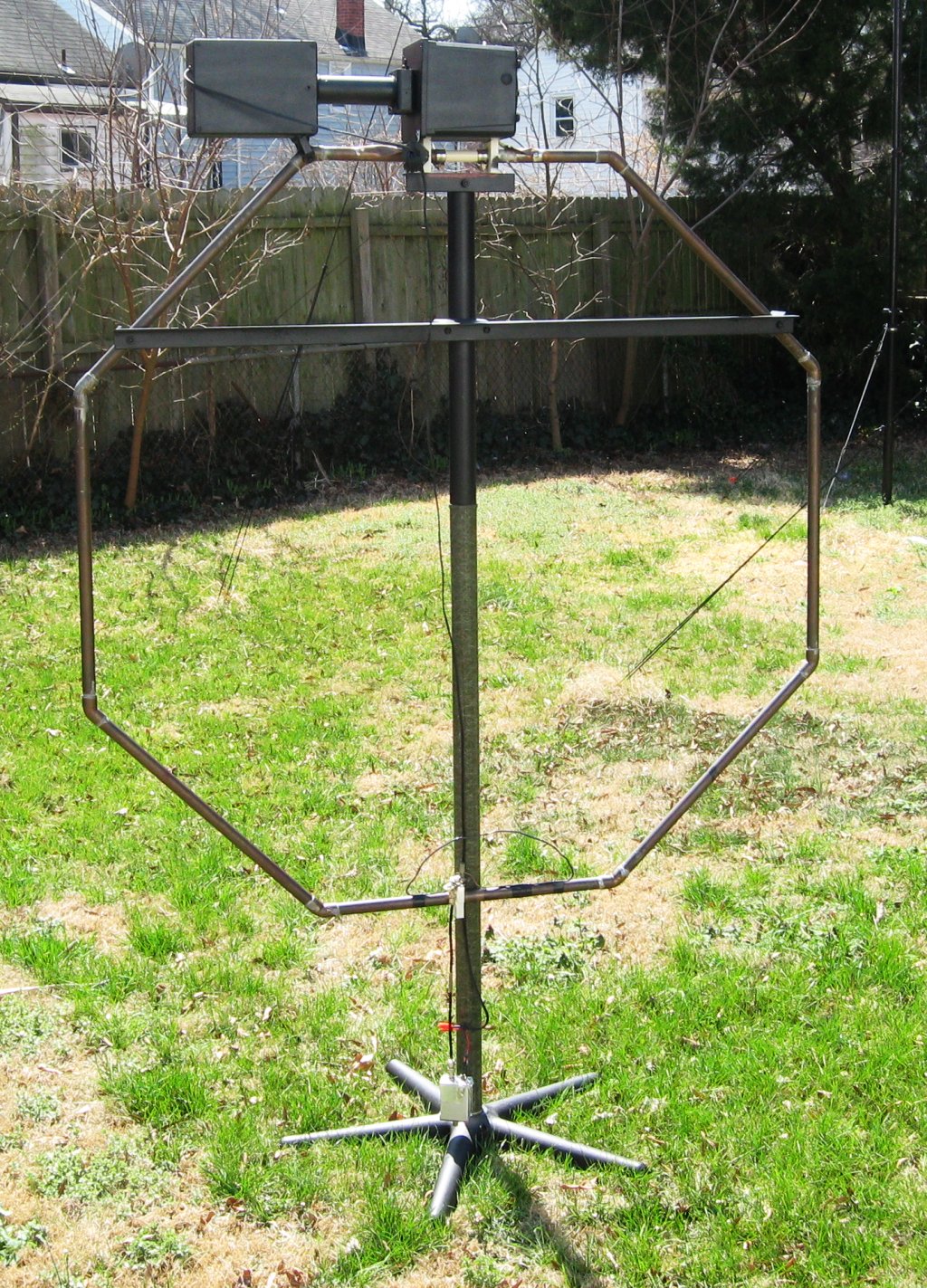
Talk of capacitors and high voltages make magloops sound daunting.  They're really not.
 
The drinks cans, being very thin aluminium, have an annoying tendency to distort once the ends are cut off, and they then tend to make contact with one another when they should slide without touching.  I suppose you could use steel, though there may be some reduced performance; I don't know.  That said, never knock something that allows you to make a start, however flaky!  After a few goes, I could manage to get an SWR of 1.3:1 by ear - and no ATU!

The headache with mag loops is the very sharp tuning - slide that capacitor just a wee bit and you are past the sweet spot by a mile.  With the drinks can, although you can rig up the syringe and airline tubing system (which I did), it quickly becomes tiresome to tune the loop.  You could fix the capacitor in place if, for example, you are only interested in WSPR or one of the ROS frequencies.  But that's a pretty inflexible antenna.

The best option is to forget the drinks can capacitor, even though it does work and costs next-to-nothing, and go for a proper air-spaced capacitor or, heaven forbid, buy a decent used vacuum capacitor.  Russian ones, which have a good reputation, are available on e-bay all the time, but you have to be careful who you buy them from.  MFJ also make a capacitor you can buy.  All these things will tend to set you back about £100, possibly a bit more.  You will then need to get a slow-motion DC motor to remotely tune.  In all, even buying a capacitor and motor, you will probably save about a half on buying an MFJ magloop (about £430 RRP), and a lot more on the much better-built Baby Loop by Wimo (about Euro 1100 list at time of writing.)  

The Wimo Baby Loop.  Euro 1100, but look at the quality - and the capacitor!!


Even with tuning of the cans being a bit of a hit-and-miss affair due to their flexure, the magloop showed itself to be a very good antenna.  It compares very favourably indeed with my full-wave delta loop, giving the same or only slightly lower signal strengths on SSB.  SSTV signals were also stonking in in glorious 595 from across Europe.  I haven't had time to mount in the open and try WSPR tests yet, but that will have to wait for a proper, more stable capacitor.  My first morning of operation brought in UN7LDZ (Kazakhstan) on about 20W actual output on RTTY.  That's not bad going for a loop indoors, a foot off the kitchen floor!

As a first test, my magloop confirms the oft-quoted view that it's the best small HF antenna you can get, giving full, 30-foot high dipole-like performance when mounted only a few feet off the ground.  With a proper, remotely-tunable capacitor, I expect this will be a very interesting antenna to experiment with, especially when it is, as so often, blowing a hurricane up here.  Heck, I can even use it indoors, or have it sheltered in the kids' tree house!  

UPDATE:

I've now ditched the drinks can capacitor.  It worked fine, but it just isn't controllable enough for external use.  I've now rigged-up a trombone or piston type capacitor using 1/2" copper tube, insulated with PVC tape, running inside 3/4" copper tube.  This is much more stable, though I had to wind three thicker parts of PVC tape to the inner plates to make them run centrally.  To push the plates in and out, I used threaded rod on a couple of old bent mouse traps that act as brackets, and Araldite-glued two nuts onto these to act as smooth runners.  Not only is this fine tuning by hand, it allows a pretty bog-standard motor to be used to tune as well; the threaded rod acts like a reducing gear of sorts. It's still not easy to tune without a remotely-operated motor, but it is certainly better than cans!


The new, improved 'trombone' or 'piston' capacitor after soldering.  Keep the pipes parallel when making these! 

Tuning with this system is restricted to the 20m, 17m and 15m bands, with 15m being a bit tricky as the capacitor is running out of legs by then!  A butterfly capacitor would be a huge improvement, but I haven't got one at the moment!

One curious thing I noticed just by indoors operation was that the antenna seemed to work better end-on, rather than broadside.  When I checked the pattern outside, with the base of the antenna at about 2m, the vertical radiation off the ends was seen to be considerably stronger than the horizontal radiation off the face of the loop.  Not sure if that would still be the case if the antenna was placed at a reasonable height.  I guess it would even out then.

A beautiful loop.  The secondary loop is made of heavy-gauge domestic earth wire.  I found the SWR drops significantly (by half an unit or more) if the loop is kept higher, rather than lower on the support.  More playing is needed to see if the shape and position can lower it further.

I've managed to have two hours on WSPR now, and during last evening, managed to get across to Wake Island - a military bit of US sand in the middle of the Pacific, Japan, Taiwan,  all of Europe, Morocco, Venezuela and the far west coast of the US.  Not bad at all for a small loop running 5W!  Luckily, G3JKF was running his twin loop at the same time, an antenna at a much more advanced stage of development, and signal reports into Taiwan, for example, were identical.

Just under 2 hours' worth of WSPRing with the magloop outside, base at 2m.  Pretty impressive!

Certainly an antenna worth having.  I would even buy one, to be honest.  A heavy-duty Baby Loop from Wimo is very expensive, but stick that on top of a decent tower, and you get really quite respectable low angle radiation and gain figures.  But if you are any good at electronics and motors, you really could have a very good homebrew, remotely tunable antenna for peanut money.

In fact, coming to think of it, the magloop is by far the most interesting and fun antenna I have worked on so far.  I would go so far as to say every ham should have one; certainly those starting out.  This is not least because a magloop is a very capable, relatively affordable, also relatively easy to build antenna that has the huge advantage of almost certainly not needing planning permission in the vast majority of cases (private restrictions are another matter, but even then, magloops work really well inside non-steel buildings.)  From my perspective, it's a hurricane-resistant, small, portable antenna.  Quite remarkable, really.

Sunday, 5 May 2013

6m Season is Coming!

Catch the 6m E season with this quad.


Being May (2013) I thought of an antenna for 6m.  I like quads for their simplicity and excellent performance.  They are also very cheap to make!

Rather than repeat what others have already very well done, here is a link to an excellent article on 2 and 4 element quads for 6m, all in the $$$-busting spirit of this blog.
 
Happy E-ing!


Sunday, 28 April 2013

RSGB Web Revamp

As part of its now long-running efforts to modernise and govern itself properly, the RSGB has now got a new web front page, beta style.

Fair play, they've got one bit right: limiting the choices on offer to just three; it's important not to overload people hitting the page for the first time yet getting them sufficiently interested to find out more.  I think they've hit the mark with this, so well done.

But things fall apart quickly from here on in.  I clicked on the bit where I might be slightly interested in becoming a radio amateur but have confused ideas about what it's all about.


I dunno.  A nice shot like this might attract me to amateur radio.  Gets me outdoors, type of thing...

What do I get?  Text.  Lots of it.  I'm afraid it's an instant turn off.  There are no images of exciting equipment, happy operators or anything else.  It's a big disappointment, frankly.

Erm, no.  Not that kind of image.
It needs more work, and plenty of it.  Urgently.  And the current lack of interest amongst the web page content is probably not down to poor web creators; it's much more likely them doing what they're told to, which is the wrong thing in my estimation.

How about some satellite or ISS images?  Might be attractive to some...
 
Come on lads.  There is plenty of technical and outdoors excitement in amateur radio.  Put some images on there, for God's sake!


Monday, 22 April 2013

SSTV - And a Trip Back to the 1970s

I started playing with SSTV the other day.  Far from being anything like TV, the whole mode seems to be more like analogue file transfer, mediated by digital computers.

Within minutes, I was receiving admirably good quality images from across the EU, with the odd one from south America.  There's something undeniably interesting about SSTV and its digital (and more error-free) counterpart.  But there's one thing I found really unappealing.

One of the more tasteful female images on SSTV.  Others are a bit more, well, revealing...

Images of naked women.  Lots of them!

SSTV indeed seems to be the amateur radio equivalent, for the most part, of a private top shelf channel.  Naked women, scantily-clad ones, fully dressed attractive ones, and ones draped over cars.  They're all here in abundance.

Lord knows what kick anyone gets out of sending such images to one another over radio, and maybe that's why there only seems to be a small, if you'll pardon the pun, hardcore of SSTV operators.  Some do reciprocate my own interests in non-female imagery, and send a sexy picture of a helicopter or aircraft.  But they're not common.

This kind of thing harks back well into the dark ages of 1970s Britain, where sexism was rampant.  It tells us of the ageing population of the radio community, reflects on some rather slow-to-change nations and their attitudes to women and, of course, entirely lacks any female input for lack of any female operators. 

Time and again people wring their hands and wonder why so few people are taking up an interest in the hobby.  Here's yet another glaringly-obvious reason, especially if you happened to be a younger operator, or a woman, or both - none of which seems to bother any of the senders of daily red-top newspaper images that ply their way across the airwaves.


Monday, 15 April 2013

The Future of Amateur Radio - Are Magazines and Societies Just Missing the Point?

It's been another windy period over here for the past few days.  When it's gusting 60, 70 or more miles per hour, it's not time to have complex, expensive antennas up in the air.

Instead, it's time to deploy simple, robust wires like my trusty G-Whip end-feds, a surprisingly effective antenna for the price, easy to deploy in seconds and yielding a near-perfect match across the 20m band.

G-Whip matched end-fed for 20m.  Up in seconds, low cost, global DX.  So why are we bombarded with super-expensive images of amateur radio?

But it's a constant source of irritation for me that, when amateur radio is in a crisis of so few taking up the hobby, far too much emphasis is going on expensive equipment that only the rich can afford.

This is a huge shame, because this evening, with only a 10m-long piece of wire, a matching circuit at the base and a rig, I'm using the latest free digital mode software to get signals into really rather remote parts of the world - all on 30W or much less.  If, sadly, like so many, you live in an urban setting and have intolerant neighbours, such an antenna is unlikely to need planning permission, and if someone really likes complaining, then it can go up and down on a fishing pole in seconds, or be attached to a chimney or such like.

So, if global DX can be pulled in with such simple equipment, shouldn't amateur radio societies, DX clubs and magazines be pushing this stuff instead?  Sellers who want to push £3000 rigs and equally expensive antennas on top of mile-high towers are only going to get away with that sort of marketing strategy for so long; give it about 10 years, and there will be few with that kind of money and the passion in the hobby left.

In other words, those selling advertising space - and those buying it - are simply rushing headlong into amateur radio oblivion in a few years' time.

It's fine to build up your station and work towards towers, yagis and so on - if you really do need them as opposed to never bothering to find out if something simpler might work as well or even better (keep low angle radiation in mind!) But I fear that for a very long time, the hobby has been dominated by the most accomplished, most complex and most expensive operators and those that furnish them with their materialistic wants.  That really is no good at all.

So it's time to ditch the glitzy, blingy, macho attitude and start coming down to earth in order to promote and save amateur radio for what it really is at the bone: self-education, experimentation and making your own stuff for little or no money.  The digital mode revolution has the capacity to catch the imagination of today's computer generation, so let's get that message out, instead of endlessly creating an image that hamming is only for the rich and retired.


Friday, 12 April 2013

ROS Mode

Having had very good, if rather slow-paced success with the JT65 digimode, I somehow found myself playing with ROS mode the other day.

I think it was because someone had spotted a ROSer on the 20m cluster, so I downloaded the free software, see what mess I could get myself into.

My kids love the look of ROS, with its many little clocks and musical notes!


As usual, it takes a little while to learn your way around the macros and the commands peculiar to the software.

In fact, once settled-in, I found the ROS software to be one of the most carefully thought-out pieces of code going.  It lets you resize the window within the software, so you can see everything that's going on.  It connects to the rig seamlessly and with few mouse clicks.  It brings up a link to the QRZ.com page of each callsign, and even a link to short and long path circuit reliability for the band in use.

ROS is not as immediate as PSK, for example.  But you can have a fairly rapid  real-time typed QSO at selectable speeds, and it's much more powerful in covering global distances with few or no decoding errors at QRP and slightly above QRP powers. Each halving of character sending speed effectively doubles your power, so tortoise and hare can apply if conditions aren't so hot.

After just two days of ROS working, I've added two new DX entitites to the log.  I also rather like ROS for the fact that it's so well thought-out, and has relatively few users on 20m, increasing the chances greatly of grabbing those rare DX calls.  ZL2AUB, who features in the above screengrab, has become a daily check-in, which is also very nice!


Wednesday, 20 March 2013

SteppIR Performance From Two Wires

If you spend any time on the bands these days, it won't be long before you hear the term "SteppIR" being used by enthusiastic aficionados of big, rather costly to buy antennas.

SteppIR antennas are indeed very nice antennas, and extremely popular in the more affluent parts of society.  They are also, of course, not the only 3-element yagis available, just, perhaps, the best.

A SteppIR 3-element yagi.


But can SteppIR-like performance be attained for a lot less than the current (March 2013) manufacturer's list price of $1826 (product number 00203)?  The answer is, surprisingly, an emphatic yes!

Now, I am not comparing like with like, obviously, so the comparison only holds for the 20m band for the moment.  SteppIR give their gain figure for the 3 element yagi as 7.4dBi at the 20m band.

But, what happens if I add a reflector element to my existing delta loop antenna?   The question is important because my delta consists of a sub-£100 system comprised of wire, a fishing pole and a 4:1 balun.  The second element costs less, because it's just a loop held up by another fishing pole with no need for any balun or cable to connect anything.  What's more, the base of the antenna is only at 2m above ground.

The modelled answer is a gain almost exactly the same as the 3-element SteppIR - I kid you not.  I ran WSPR tests to see how the as-yet imperfect set-up I have does really deliver.

Yours for very little money: a 2 -element delta, peak gain about 7.4dBi.
 
And it does!  The signal received stateside (direction of fire) increased by a mean of 5.5dB for that limited test, which you must remember is just adding another piece of wire that's a little longer than the driven element but not tuned yet, and a spacing that is only roughly worked out on normal formulae, and not optimised for peak gain yet.  A fair wind also led to some variation in performance due to a swaying fishing pole.

On limited SSB tests, a station in Tennessee was pushing a very respectable 54 using two elements, but was down to a miserly 3/1 on just one element.  Noise is dramatically down with two elements as well, indicating a respectable F/B ratio (probably about 10dB.)  I also had a nice session on 10m PSK into Latin America using the double delta.

So, whilst we are not quite at SteppIR-busting gain, we're pretty darned close without any optimisation at all.  For a few pounds/dollars, we've got a 20m beam that is easy to put up (and down!), doesn't need a tower and gives us about an extra 'S' point on the signal.  What you do need is a fairly reasonably-sized garden to accommodate the two elements for this band.  You will also need a means of moving things around if you want to change the direction of fire, in which case, the image above shows what must be by far the easiest way of doing it, though suspension from a decent tree is also possible if you have one tall enough.

Unfortunately for me on a wild hillside, I will now need to make a double delta, single support antenna that can also be easily retracted, redeployed and rotated - quite a tall order!