Showing posts with label magnetic loop. Show all posts

Tuesday, 27 November 2018

Magnetic loop - 40m WSPR results

Well, nobody can claim I am not thorough!  After a very favourable outcome at 14MHz for my car-portable magnetic loop mounted at 2.5m base height, I had a similarly successful result at 10MHz.

How would this small loop, 3.9m total perimeter, in 15mm pipe, do on 7MHz?  A loop of somewhat larger perimeter and 28mm pipe has done extremely well here in the past, but I didn't expect so much from a loop primarily designed to fit in a car.

Matching is via my usual pseudo-gamma ('wire up one leg') system, which provides a combination of induction, direct coupling and loop mode energising of the main loop.  It all goes through a 4:1 balun, although a 2:1 or 1:1 balun - or no balun - will usually also work.  SWR at resonance was 1.05:1, done with a SARK 110 analyser.
A lot smaller, and infinitely easier to deploy than a wire antenna at 7MHz.

Well, I always choose to put my antennas to the test against the best-performing WSPR stations to be found in the UK.  At 7MHz, M0PAI was the comparison station.

Here's the distance plot for both stations.  Note the very clear dips at post-sunset and pre-sunrise grey line periods.  I've never seen such a clear example before, which was aided by some of the quietest geomagnetic conditions, even at high latitudes, I've seen for a while:

Across all distances, the magnetic loop is only 8dB down on what I think is a full-sized G5RV at 7MHz:

This difference reduces to just 6dB when looking at DX distances, noting there were not many simultaneous DX spots.

Also note that the DX situation is an average.  Looking at the plot of spots, the highlighted station was, at that moment, hearing my loop 1dB above M0PAI:
Once again, the message is clear: magnetic loops work, and can compare very favourably for their size and ease of deployment, against full-sized wire antennas.  This is especially true when one can deploy a loop in a high quality environment.

It's also interesting to note that, even though it makes no allowance for environment, the 6-8dB difference is exactly in line with the efficiency of the loop predicted by this online calculator, which yields a 7.5dB reduction from 100% efficiency, yielding an overall efficiency for the loop of 18%.  This is not the same comparison as testing the antenna itself, of course, as there are various radiation pattern effects and environmental gain to take into account for both the loop and wire antenna.

IMAGES - ESPECIALLY FOR PE4BAS!


Monday, 29 October 2018

Figure-of-Eight Magnetic Loop - WSPR Results.

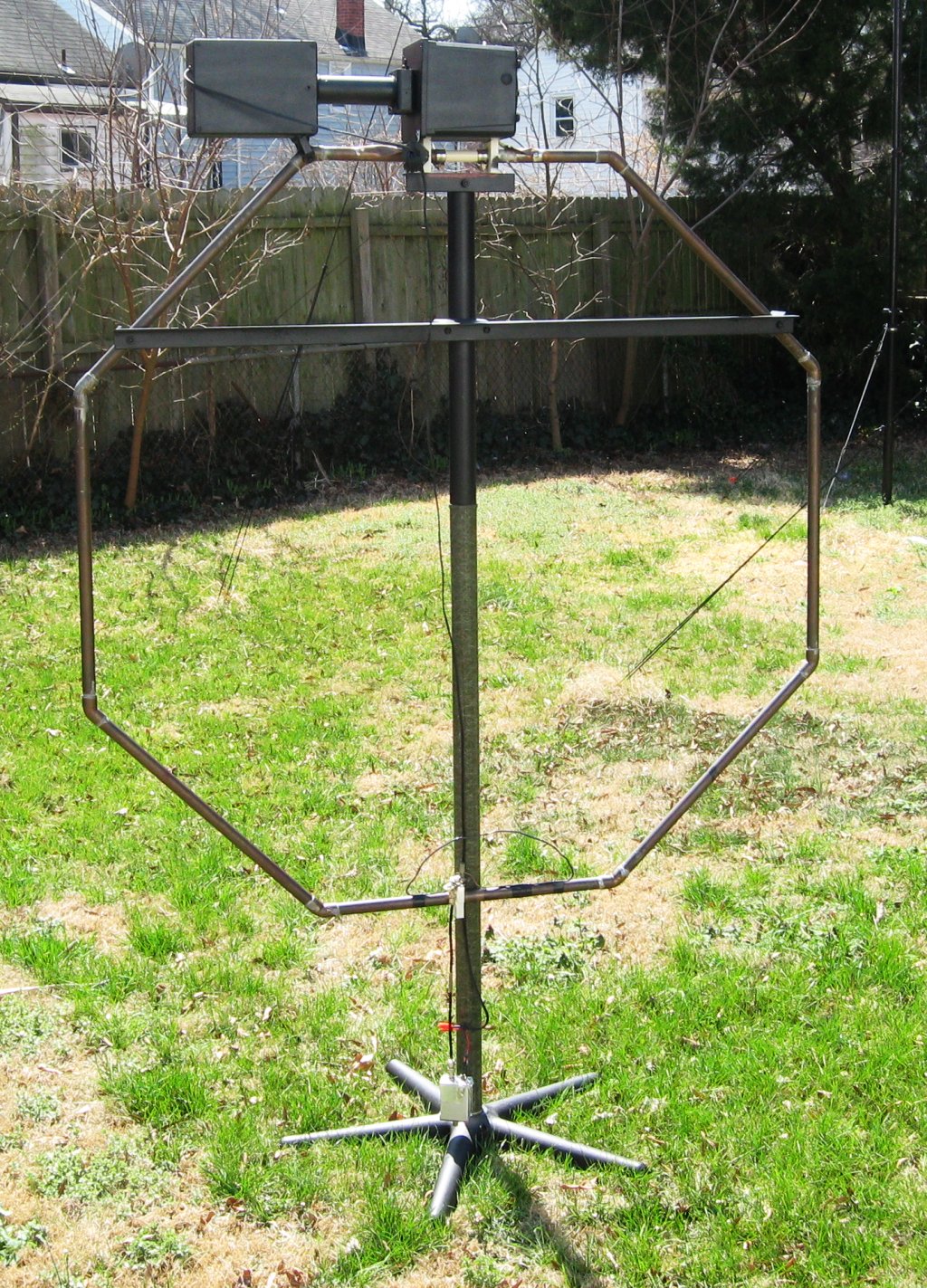
Last week, I built a 75cm-diameter (per loop) 'Meight', or figure-of-eight magnetic loop, to see how well it would perform compared to other loops I've built.

The comparison antenna, as is usually the case, was that run by GI8YJV in Northern Ireland.  At least at 14MHz, this trapped dipole outperforms just about everybody else in the UK on WSPR, and almost exactly mirrors the performance of my very well-matched, twin-fed vertical delta loop.  The difference in latitude and longitude is also minor.

I also use G8LIK as a comparator, as he is using a large 'Skywire'-type, horizontal loop that also performs very well, albeit with clear signs of having more skyward radiation than low angle.
My homebrew figure--of-eight loop, graced by the Moon at sunrise, 29/10/2018.  Note the feed has now changed (below)
New feed, with wire external to and well away from the loop yields less minor SWR drift in rain.
 
Now, if you are one of those people whose mind is more fixed than flexible, than please do remember that this test is, and is only claimed to be, of a small transmitting loop antenna.  Its virtue lies in being small, works close to the ground, and is either outside planning regulations or very unlikely to warrant enforcement action in most countries.  It can be deployed indoors and on balconies.  This is not a comparison with a Yagi on a 100 foot tower, which is a huge investment of time, effort, money and space.

I have been quite pleasantly surprised with this antenna.  For one thing, it's very easy to build for very little money.  Secondly, it has proven to send out a good signal.  Mounted vertically on a low post (base ~1.5m), the loop was giving the GI8 dipole a good run for its money.   Even better, it consistently outperformed the large wire loop.

I felt the loop was working so well, even getting 200mW at good strength into west coast USA, that I hurriedly mounted it at a better height (base ~2.5m) for more tests.  This did yield a small but detectable increase in performance.  That said, the increase was not such that you would lose out in an appreciable way if you were restricted to using it on a lower, ground-mounted stand (which also has the advantage of being easily turned, for directivity).

So, let's look at about 3 days' worth of WSPR results.

First, the magloop vs. the trapped dipole at GI8YJV:


That's a pretty good result, considering the size of the magloop.  Now let's look at the simultaneous signals beyond 5000km, i.e. DX distances, to see how well each was being received by the same stations, at the same time:


The magloop is 5dB weaker than the trapped dipole.  It's about 6dB worse on local signals, but that's not usually of interest, at least to me.  That is pretty much what we might expect, and translates into just a single 'S' point down on the trapped dipole, if considered in the increasingly-irrelevant tradition of SSB signals.  In digital operating, 5dB is going to see you get through to almost all the places that the trapped dipole gets to, as the map of receiving stations illustrates:


Interestingly, the loop is able to match the dipole at times, even at the extreme DX range, though not necessarily at the same time:


When compared to the large wire loop at G8LIK, the magloop exceeds its performance by a very wide margin, most likely explained almost entirely by the better low angle, vertical radiation from the magloop, as evidenced by the big differences towards the late afternoon and early evening:


I'd like to show you other comparisons, but it's not easy to do.  First, you get a lot of people who only operate WSPR for a few hours, or a day or so.  Then you get people who operate continuously, but are anti-social in not publishing anything at all about their station, or providing a means to contact them to ask!  MX0PHX, a club station using a low, OCFD dipole, is the only other reliable station I can choose.  Whilst only at 4m up, the antenna is at least in an open, rural site.  The magnetic loop compares very favourably with this full-sized wire dipole:


In terms of signal strength at DX distances (set at >5010km), the magloop actually comes in at over 2dB better than the OCFD:


Whilst the 'Meight' loop is taller than a single loop, it is quite rigid, even in 10mm copper pipe.  The second loop adds another point of attachment at the top.  This is how strong this all is in the 100km/h winds of ex-Hurricane Oscar this morning (03/11/18):

One thing you do need to do is make sure that the capacitor and all connections to/from it, including those to the motor, remain dry.  My loop showed a small but definite SWR drift over time, which I eventually realised was caused by water getting in between the capacitor vanes!  Remarkably, this didn't seem to make an enormous amount of difference to the loop performance, though the SWR was far too high.  Sealing the cap housing ensured dryness, and now the SWR drift when it rains is very slight, remaining below 1.4:1.  There is probably more that can be done to prevent stray capacitance in wet weather, but it's not something to worry about at the moment.

All things considered, the 'Meight' is clearly an efficient antenna whose size, convenience and sheer possibility of being deployed when larger antennas may be prohibited, means this is very much worth building, regardless of whether you have a large antenna farm, or a HOA flat.

You can of course buy a 'Meight', which does have the advantage of automatic and manual remote tuning.  But, at £504, that's an expensive tuning circuit!  It's also the case that the commercial version comes delivered to you in sections.  Each connection will involve some loss, especially as they are not soldered, but mechanical compression fittings. 

UPDATE: 19 days of WSPR

All compared to MX0PHX (OCFD at 4m height, in open, rural area).

(1) Simultaneous spots, all distances:


(2) Simultaneous spots, DX distances (>5010km):

(3) DX Graph:

(4) Spots map:


(5) Magloop compared to GI8YJV(top WSPR-performing trapped dipole):


Saturday, 25 November 2017

15m Magnetic Loop Tests

Love them or hate them, magnetic loops remain a fascinating antenna concept.

Over the years, I've built quite a few magloops, more recently being inspired by the work of G3JKF and other, careful experimenters.  I did go through a period of disillusionment with loops, but came back to them after I realised that some of the less impressive results were simply the result of too much operating them indoors.

Since the advent of the digital weak signal modes, the need to 'QSY' - or change frequency to make different contacts - has, in effect, been eliminated.  You just dial up the mode's standard frequency and shift the audio tone up or down.  So the traditional 'problem' of loops being very high Q, narrow bandwidth antennas has also, as a result, become less of an issue.

To reduce costs and space requirements, I built a small loop for the 15m band yesterday.  Instead of the usual copper pipe, I used a spare, 1.5m-long piece of thin brass sheet about 100mm wide..


The advantage of sheet is that it is flexible, and can conceivably be 'unlooped' and removed from the support structure in larger antenna builds where car transport to site might be a consideration. Other than potentially being a bit too much like a wing in windy weather, I wasn't sure if the sheet would display any disadvantages. 

I ran the loop on WSPR using 1 Watt, though because of cold, windy and very wet weather, I kept the antenna and its unhoused air spaced capacitor inside my kitchen-cum-shed-cum-shack.  You have to take this into account when evaluating the outcome.

First, here's the distance plot of my loop, indoors, against an M6 station with a Cobwebb antenna at 200mW on top of a high rise building, with a nice, semi-rural aspect all around, in Kent.


Looking across without much analysis, and taking into account the different power outputs, the signals appear, on average, broadly the same.  Let's look at how the simultaneous spots results come out:


Unfortunately, there are not very many simultaneous spots.  But there are just about enough to make the outcome somewhat reliable.  The difference in favour of my antenna is 5.5dB, which supports the subjective assessment of the distance plot as being similar, because the M6 station is putting in about 6dB more signal into his antenna (which, remember, is outdoors on a high-rise building).  Also, the magloop is directional (I was running the main, vertical lobes in a NW-SE direction).

When looking at the geographical plot of spots, it does seem that my loop is able to take advantage of the good ground gain afforded by the local environment.  One spot (highlighted) shows an enormous, 16dB stronger signal for my loop over the Cobwebb.  And the only other US spot, from Florida, was of my loop - the Cobwebb didn't make it.  Whilst these are very few spots on which to make firm conclusions it does, at least initially, look quite good.


The following day, I was pleased to see G3JKF had joine me on a rather dead 15m band.  An EA8 station provided the only spots for most of the day, which at least made comparisons simple!  Later, I heard a 9L station but, unlike G3JKF, did not receive a spot from him.

Overall, the results are again quite encouraging - only a 1.5dB advantage for G3JKF, with a triple array in a good outdoor environment.


If you're new to loops, you'll notice that G3JKF and my loops never use the primary, 'Faraday' loop feed mechanism.  Those can lead to trickier matching.  We both use what could be described as a pseudo-gamma match - a mixture of direct and induced coupling, and usually running through a 4:1 balun.

You can find plenty of good images if you search 'magnetic loop gamma match' online.  But I would caution that all my loops show best matching when the gamma match is connected a good 1/2 to 3/4 way up one side of a loop, rather than the much shorter feed shown in most images.  An antenna anlayser makes progress infinitely quicker than being without one.  Use a crocodile clip on your centre pin matching wire for initial investigations of the best point for your feed to attach, then you can mark and solder the wire permanently, without the clip.


Over the weekend, I made this four parallel loop array, nominally for the 15m band.

Today, I'm running the new, four loop array for 15m made from 10mm microbore copper tube, but now outside, despite currently experiencing some windy, very cold weather from the Arctic!

Dry. if cold weather permits some WSPR testing at 21MHz


The results, running against G3JKF's triple-loop array now follow.

First, the plot of distances achieved, remembering that 15m is quite quiet at the moment, and that for much of the day, only one station was hearing us (EA8):


This result was fairly poor relative to G5TA's multiband vertical, though one has to remember the loop is only the size of a supermarket shopping bag:


Compared to G3JKF's loop, the outcome in terms of signal strength was, allowing for the low number of spots, the dramatic, rapid swings in propagation on 15m, and a difference in latitude that generally favours southern England over north west Wales, my loop is doing reasonably well and perhaps much the same.  For about an hour in the morning, my unweatherproofed loop and vacuum capacitor was also soaked by a big shower, which impacted its matching to the extent of raising the SWR from 1:1 to 1.5:1 until the cold Arctic air dried it out.


Overall, I can certainly say my loop is working almost or as well as G3JKF's loop, which is reassuring in terms of build quality.  My loop could be a bit higher, but that can't be addressed for the moment.

Unfortunately, 15m is too variable a band at the moment, and too quiet overall to permit a good set of data to be collected that yields a robust comparison with either G3JKF or much of anyone else.

That said, I did run a one-after-the other series of tests over a couple of hours, comparing the loop with my vertical delta loop for 15m (via a 2:1, corner fed, SWR = 1:1).  The result?  Lots of QSB that made comparisons tough even on a 4 minute timescale.  But a figure of about 7dB in favour of the delta loop eventually emerged from the noise.

7dB against the magnetic loop will be a killer for many - hence the 'dummy load' claims that are made.  But nobody, graced with lots of space and no neighbours to complain would use a magnetic loop as a first choice.  Magloops are for those with much less space, perhaps wanting some noise reduction, and the ability to use an antenna across multiple bands, perhaps from indoors.  With an indoors 1.2m-square loop, I've had good SSB QSOs as low as 60m using just 35W.  With digital modes, the possibilities are quite good.

Still, now you know that a reasonably effective 15m loop can be built from 10mm microbore copper tube, merely by cutting four loops out of the coil of tube that comes wrapped in plastic in a shop and soldering them to two pieces of 15mm copper tube or stiff copper strip - no bending required!


Monday, 6 May 2013

HF Magnetic Loop - In An Afternoon.

It's been a very long winter and, with the sun finally out and the weather warm, all that pent-up antenna building energy had to come out!

So, on the bank holiday, I decided I would have a go at a magloop for HF.

Magloops seem to have a bit of an air of mystery about them.  This seems to be down to two things - the need for a tuning capacitor of high voltage handling, and the very sharp tuning range.  Neither, in practice, are anything to worry about.

I was sorely tempted to scavenge a capacitor from my ATU, which these days tends to lie rather redundant owing to my improved antenna-building skills.  But I opted first for the drinks-can capacitor system, as it's cheap and is interesting to make.  You can see a fine image of the capacitor courtesy of Alex, PY1AHD below:

Looks unlikely, the cans are a bit weak and unstable, but it does work.

The loop was made to a square profile using 15mm copper tube; shape doesn't seem to make a huge difference, but a square is, some say, somewhat less efficient than a circular profile.  In the International Antenna Collection book, a professor says shape makes very little difference.  A square is infinitely easier to construct, so you may want to weigh up the costs and benefits when wondering whether to roll some copper!  I'm mostly interested in the 20m band, so I built the loop to be about 5m all the way round.  Remember to clean those joints and use flux for a good fix!

Talk of capacitors and high voltages make magloops sound daunting.  They're really not.
 
The drinks cans, being very thin aluminium, have an annoying tendency to distort once the ends are cut off, and they then tend to make contact with one another when they should slide without touching.  I suppose you could use steel, though there may be some reduced performance; I don't know.  That said, never knock something that allows you to make a start, however flaky!  After a few goes, I could manage to get an SWR of 1.3:1 by ear - and no ATU!

The headache with mag loops is the very sharp tuning - slide that capacitor just a wee bit and you are past the sweet spot by a mile.  With the drinks can, although you can rig up the syringe and airline tubing system (which I did), it quickly becomes tiresome to tune the loop.  You could fix the capacitor in place if, for example, you are only interested in WSPR or one of the ROS frequencies.  But that's a pretty inflexible antenna.

The best option is to forget the drinks can capacitor, even though it does work and costs next-to-nothing, and go for a proper air-spaced capacitor or, heaven forbid, buy a decent used vacuum capacitor.  Russian ones, which have a good reputation, are available on e-bay all the time, but you have to be careful who you buy them from.  MFJ also make a capacitor you can buy.  All these things will tend to set you back about £100, possibly a bit more.  You will then need to get a slow-motion DC motor to remotely tune.  In all, even buying a capacitor and motor, you will probably save about a half on buying an MFJ magloop (about £430 RRP), and a lot more on the much better-built Baby Loop by Wimo (about Euro 1100 list at time of writing.)  

The Wimo Baby Loop.  Euro 1100, but look at the quality - and the capacitor!!


Even with tuning of the cans being a bit of a hit-and-miss affair due to their flexure, the magloop showed itself to be a very good antenna.  It compares very favourably indeed with my full-wave delta loop, giving the same or only slightly lower signal strengths on SSB.  SSTV signals were also stonking in in glorious 595 from across Europe.  I haven't had time to mount in the open and try WSPR tests yet, but that will have to wait for a proper, more stable capacitor.  My first morning of operation brought in UN7LDZ (Kazakhstan) on about 20W actual output on RTTY.  That's not bad going for a loop indoors, a foot off the kitchen floor!

As a first test, my magloop confirms the oft-quoted view that it's the best small HF antenna you can get, giving full, 30-foot high dipole-like performance when mounted only a few feet off the ground.  With a proper, remotely-tunable capacitor, I expect this will be a very interesting antenna to experiment with, especially when it is, as so often, blowing a hurricane up here.  Heck, I can even use it indoors, or have it sheltered in the kids' tree house!  

UPDATE:

I've now ditched the drinks can capacitor.  It worked fine, but it just isn't controllable enough for external use.  I've now rigged-up a trombone or piston type capacitor using 1/2" copper tube, insulated with PVC tape, running inside 3/4" copper tube.  This is much more stable, though I had to wind three thicker parts of PVC tape to the inner plates to make them run centrally.  To push the plates in and out, I used threaded rod on a couple of old bent mouse traps that act as brackets, and Araldite-glued two nuts onto these to act as smooth runners.  Not only is this fine tuning by hand, it allows a pretty bog-standard motor to be used to tune as well; the threaded rod acts like a reducing gear of sorts. It's still not easy to tune without a remotely-operated motor, but it is certainly better than cans!


The new, improved 'trombone' or 'piston' capacitor after soldering.  Keep the pipes parallel when making these! 

Tuning with this system is restricted to the 20m, 17m and 15m bands, with 15m being a bit tricky as the capacitor is running out of legs by then!  A butterfly capacitor would be a huge improvement, but I haven't got one at the moment!

One curious thing I noticed just by indoors operation was that the antenna seemed to work better end-on, rather than broadside.  When I checked the pattern outside, with the base of the antenna at about 2m, the vertical radiation off the ends was seen to be considerably stronger than the horizontal radiation off the face of the loop.  Not sure if that would still be the case if the antenna was placed at a reasonable height.  I guess it would even out then.

A beautiful loop.  The secondary loop is made of heavy-gauge domestic earth wire.  I found the SWR drops significantly (by half an unit or more) if the loop is kept higher, rather than lower on the support.  More playing is needed to see if the shape and position can lower it further.

I've managed to have two hours on WSPR now, and during last evening, managed to get across to Wake Island - a military bit of US sand in the middle of the Pacific, Japan, Taiwan,  all of Europe, Morocco, Venezuela and the far west coast of the US.  Not bad at all for a small loop running 5W!  Luckily, G3JKF was running his twin loop at the same time, an antenna at a much more advanced stage of development, and signal reports into Taiwan, for example, were identical.

Just under 2 hours' worth of WSPRing with the magloop outside, base at 2m.  Pretty impressive!

Certainly an antenna worth having.  I would even buy one, to be honest.  A heavy-duty Baby Loop from Wimo is very expensive, but stick that on top of a decent tower, and you get really quite respectable low angle radiation and gain figures.  But if you are any good at electronics and motors, you really could have a very good homebrew, remotely tunable antenna for peanut money.

In fact, coming to think of it, the magloop is by far the most interesting and fun antenna I have worked on so far.  I would go so far as to say every ham should have one; certainly those starting out.  This is not least because a magloop is a very capable, relatively affordable, also relatively easy to build antenna that has the huge advantage of almost certainly not needing planning permission in the vast majority of cases (private restrictions are another matter, but even then, magloops work really well inside non-steel buildings.)  From my perspective, it's a hurricane-resistant, small, portable antenna.  Quite remarkable, really.