I was very interested to learn from fellow blogger, Bas,
PE4BAS, that radio friends in more northerly latitudes had, earlier in the week, enjoyed extensive contacts on 6 metres with Japan and other far-eastern regions.
I thought I'd take a moment today to write about the mesosphere, and ideas on how things that happen up there may allow DX to occur at 6m.
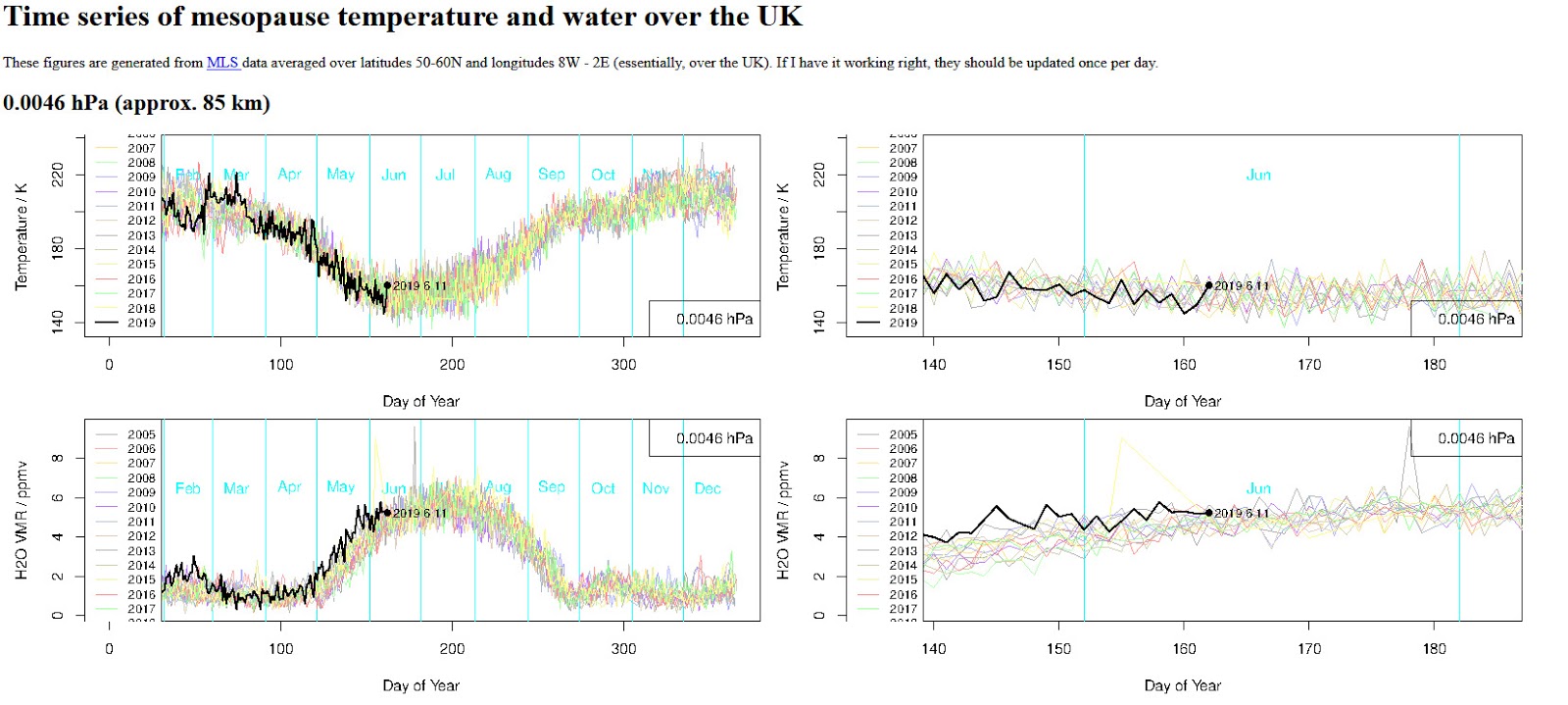
At the moment, as midsummer rapidly approaches, the middle atmosphere region known as the mesosphere, is undergoing rapid cooling. Temperatures there dip at midsummer to about
minus 125 degrees Celsius, making it the coldest region of the atmosphere. This is because of strong upward transport and expansion of warming air from below - a bit like how a refrigerator works. The graphic below shows how the mesosphere exquisitely follows the changing seasons. You can get up-to-date data
here.
 |
| AURA satellite-derived temperature and water levels over several years at mesopause height. |
The mesosphere is host to many different, but related phenomena. The degree to which these things are all related is not always a settled matter, but they are undoubtedly related.
PMSE - Polar Mesospheric Summer Echoes - are regions of ionisation that scatter radio frequencies, probably by constructive interference (simple addition of waves), from the approximate range 45MHz up to, on occasion, GHz levels.
 |
| Recent PMSE activity over mid-Wales. |
PMSE is not at all well understood. But they occur at much the same time as noctilucent clouds (NLC), and in the same region of the atmosphere.
NLC are clouds of extremely small ice particles of the order of 1 micrometre in diameter, that nucleate around much smaller, metallic particles of meteoric debris. NLC occur only in the period late May to early August each year, coincident with temperatures being low enough and water levels high enough, for the frost point to allow them to form. They can only be seen in the approximate latitude range 45-60 degrees N and S (there is practically no inhabited land in the southern hemisphere for them to be seen from - and it's almost always cloudy anyway!)
Due to their great height - typically 80-85km - the clouds remain sunlit in the NW-NE sky during midsummer's night-long twilight. Most displays reach about 15 degrees in elevation, with occasional displays covering the whole sky.
 |
| A late season NLC display, early August 2001. |
There are no known records of NLC prior to 1885, probably because the mesosphere had then reached a tipping point after roughly 100 years of the Industrial Revolution had warmed the planet just enough to allow their regular formation. NLC are probably one of the earliest manifestations of climate change.
I've studied NLC and, to a lesser extent, PMSE, for many years, and operate a
Facebook and
Twitter account aimed primarily at public understanding of these phenomena. This week,
@newman_ronan decided he would become the latest 'expert' on PMSE:
I know it's the Trump era of 'truth doesn't matter', but sadly for Mr. Newman, his assertion of fact is simply wrong. A 2011 peer-reviewed paper (Atmos. Chem. Phys., 11, 1355–1366, 2011 (Coincident measurements of PMSE
and NLC above ALOMAR(69◦N, 16◦E) by radar and lidar from 1999–2008) N.
Kaifer et al...) explains succinctly why:
Mr. Newman chose not to apologise or make further expansion on his assertions, so he ended up banned from my Twitter account - the only one ever to prompt such action.
The important thing for us is that PMSE are strongly, but not perfectly, related to NLC. The imperfection is almost certainly simply due to some NLC not reaching a point where they can be detected visually.
PMSE, incidentally, also occur at much the same time as winter Es does, which is usually explained by enhanced meteoric input at that time. It's much too warm and dry in the mesosphere for NLC to occur then. An alternative explanation for winter echoes could lie in the knowledge of a teleconnection between northern and southern hemispheres at mesospheric height.
The question now is, do any of these related phenomena of the mesosphere contribute to 6m propagation?
Well, there has certainly been plenty of debate about it - and even what appears to be entirely reliable evidence. For example, this neat account of PMSE from a ham radio perspective tells of JA contacts during midsummer.
 |
| Gravity waves modulating NLC ice particles. PMSE are modulated in the exact-same way. |
The original account by JE1BMJ of Short-Path Summer Solstice Propagation (SSSP) can be read here. Many of you who have contacted me, wondering about 6m, NLC and PMSE, will be very interested to absorb it, I'm sure.
I am no expert in 6m operating by any stretch of the imagination. But the underlying ionisation structures that are modulated by shear wave turbulence and gravity wave breaking in the mesosphere surely present themselves as obvious ways in which, at the very least, they might provide a 6m propagation path over the North Pole. The brief openings mentioned in accounts of 6m SSSP are almost certainly due to the rapidly-changing wave and other structures that occur in the mesosphere, where the underlying NLC and PMSE particles are moving westward at speeds if up to 400 metres per second!
As for sporadic E propagation, well, I'm no expert on that either. But, lying just above the mesopause region, it seems to me that Es has the same fundamental physics as PMSE, in that they are both simply complex areas of ion 'clouds' - both (if they are indeed distinguishable from one another) ready to reflect radio waves from our antennas. Some interesting academic stuff can be read here about possible relations.
Things have changed fundamentally in amateur radio recently, thanks to the plethora weak signal digital modes now at everybody's ready and free disposal. There is a lot of activity at 6m, so plenty of opportunity now to gather more data and see what they tell us.