Friday, 8 April 2022

Let's go DXpeditioning, 1947-style!

A post over on Twitter recently provided considerable food for thought about the lack of diversity in ham radio today, let alone back in 1947, when the associated video was made.

The reality about ham radio is that it's a hobby that developed in Anglo-Saxon societies (Britain and its colonies, mostly). It was almost entirely represented by white men - because only men were expected to have any interesting hobbies back then. 


The video is of its era, but still quite upsetting. Black men always appear doing the work, with white men, dressed in white, so as to highlight the difference, always look on in domineering, overbearing fashion. 

Colonial whites (skin and dress), folded arms and black skivvies. The natural order of things, as was then believed (and ruthlessly enforced).


Let's all point at the black man with a funny hat.


Today, the story is not very much changed, it is sad to say. Black people are still excluded, just as in the magazine cover, where the local man is outside, amongst the trees, whilst the white man, in colonial expeditionary attire ('safari' hat ready for another colonial 'mission', on the amp), is inside, amongst the modern radio equipment.

It's all very sad. More so, because white people of today don't really seem to see what's wrong with all this stuff.  And let's not forget, these kinds of scenes, below, were commonplace under apartheid in South Africa until the early 1990s.


Thursday, 17 March 2022

Definitely not political.

'YL Maria' (YU3AWA) has decided to tell us all how apolitical amateur radio is by, erm, spouting-off about an awful lot of political stuff. Perhaps it's better I don't add any comment to that...


Wednesday, 16 March 2022

The OFCOM-RSGB Relationship

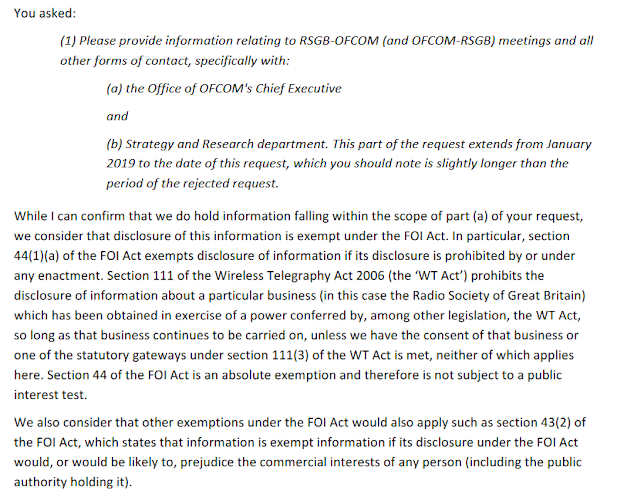
I've had an interesting response from OFCOM this week. I need not bore you with an introductory explanation, as it's all laid out in this part of the response:

This is the first time I've seen the Freedom of Information Act's provisions being trumped by the Wireless Telegraphy Act.  OFCOM do seem to have found a way to avoid being subject to FoIA when it relates to a business. 

This is another reason why RSGB's limited company status is not in the interests of the membership, as it is able to resist pretty much any scrutiny it chooses to, bar the annual business returns to Companies House.

It should be noted that there was no indication as to whether OFCOM had, or had not, sought consent from RSGB to disclose the information sought. A request for clarification on this to OFCOM has gone in, and has yet to attract a response. It initially appears reasonable to assume that OFCOM simply sought to prevent disclosure as a matter of internal culture, and didn't seek consent from RSGB.

There is more to come on short-form callsigns. I'll leave that for a post later in the week.


Monday, 14 March 2022

Propagation: always surprising.

It's not unusual to see propagation turn towards favouring the US west coast near sunset. But today, it showed remarkable precision at 14MHz (less than 100km) in which geographical area was on the 'favoured list' for an essentially omnidirectional, sloping delta loop here (output ~35W):


Saturday, 12 March 2022

Signal from Ukraine!

Amongst the carnage being inflicted upon the innocents of Ukraine, a signal unexpectedly arrived on 15m this afternoon. 


I've had QSOs with Maxim many times over the years, so it was nice to know he's OK for now. We all look forward to better times.

Inevitably, following IARU's warnings that we should refrain from posting details about Ukrainian stations being active, I had this comment over on Twitter, but no reply as yet to the question I posed:


Tuesday, 8 March 2022

Battery connections

An increasing amount of my amateur radio activities these days is done from the car. It allows freedom of location - giving access to mountains and coasts where very substantial environmental gain is available - and an escape from modern RFI sources.

For anything other than a few Watts, though, a new, separate power supply from the car's battery is required. First of all, make sure you put in appropriate inline fuses near the battery for both lines, and use cable gauged suitably for your highest expected output. Getting through the bulkhead is usually very simple, requiring a pointy pair of scissors or similar to punch a small hole through the rubber gasket where the car's wiring loom passes into the 'cabin'.

Bottom, battery-facing sides. Remarkable amount of dirt/corrosion.

Upper side. Cleaner, but still not very good.
 

I scrapped my old runaround this week, and so was removing the 12V supply lines for the radio to be reused. The amount of corrosion and dirt that had developed at the contact points was quite surprising, and potentially a source of poor contact and performance.

So, in installing the wires with new connectors on my other car, I made sure this time to place plenty of aluminium conductive grease (most readily available as 'ConductaSeal' by Innovantennas, £7.95 at time of writing) on the posts of the battery before installing the connections, and then some more on top and only then placing the nut on top, whereupon I added more grease over this.

Based on my experience with a Yagi that was out in the sea air and hurricane winds for 8 years and which made use of this grease, I fully expect bright, shiny, uncontaminated contacts the next time I remove them!