Monday, 18 June 2012

Two Bands, Not Much Dosh.

2 metres. An interesting band. Kind of handy for satellite working, repeaters, all that jazz.  How much for a handie, Mr.? 'Oh, that'll be $150 (or, defying all known exchange mechanisms, £150 in the UK), sir.' Hmm. Typing in ebay brings up a very decent looking handie. £34.99, delivered. Does 2m and 70cm.

2 bands, £34.99.  Brilliant!
It arrives the next day. Brilliant item, made even more capable with a homebrewed tiger tail attached so it has something more like a real antenna.  Kicks into the repeaters and even does distant direct contacts no problem on 2W.  You don't generally get scintillating conversation on 2m, but all the same, it's radio...

So, instead of spending mucho $$$ on a duplex-capable handie (if such a thing really exists), to do satellite working, I just got two handies for £70 and an antenna made for another £30. Two handies and a twin-band antenna for less than a badged handie. That's my kind of amateur radio!

Monday, 11 June 2012

PSK-31 - Shoestring Style

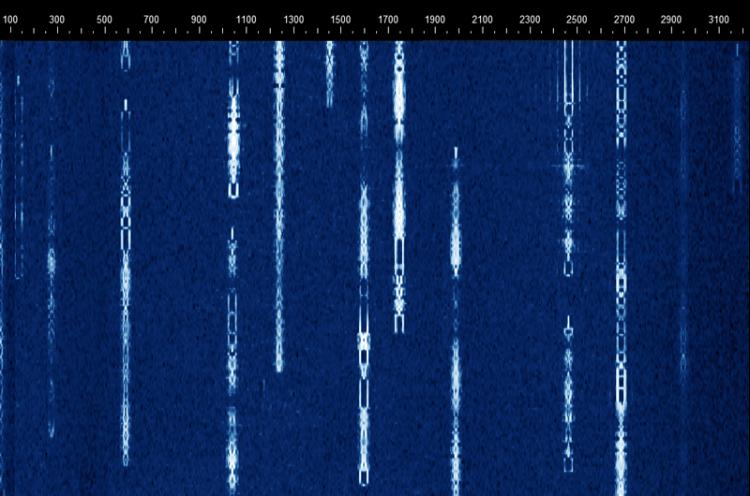
PSK-31 is a mode that I find curiously interesting, but don't know why.

True, you sit there, largely pressing macro QSO function buttons, as does everyone else.  But it is an interesting way to communicate when you feel a bit less chatty, or shouting your callsign down the mic at 3am might just wake the kids up.

How to do PSK-31 if you have the money - and a rig with the right ports.

I wanted to have a go at this mode, but had no interface.  Worse, and as usual, I couldn't find any sense on the internet as to what interface might be available for my elderly TS-50 that - shock!  horror!  has no data port.

My colleagues in the US, bless them, applied standard SAGA generation thinking and advised me to 'purchase a newer rig, then buy a Connect-o-Tron 5000' and set the jumpers to stun.'

Hmm.  Fine if you've a public sector pension, three houses and twelve 15L cars.

But where there's no money, there's a way.  I chose to think about it, helped along by the ever-helpful video meister, Randy, K7AGE.  Here's Randy looking, as ever, a bit rabbit-in-headlights:


See, Randy's good at making things simple.  He does go on to mention, in a very democratic way, the various interfaces.  That's where I lose interest, as these simple circuits cost a lot of money, typically need a lot of twiddling before they work, and then seem not to work very well.

So, having understood how it all fits together, here is my Super-Connect-o-Tron-6000 computer to Kenwood TS-50 interface:

My precisely zero-cost PSK-31 interface.  You've probably got one, too...

Now, I can hear the purist amateur radio lifestyler out there shouting 'ha ha ha, but what about your levels, your ALC?'

Well, first you pick a quiet section of the PSK part of the band, use the thing on your shoulders to set the output levels to a pretty low figure - I chose S3 to start with on the RF meter of the rig - and invite comments on the IMD level.  Nobody complained, but eventually, I found I could go down to zero S-bars, but  showing, in my case, about 5-7W out on the ATU meter) without any problems, this equating roughly to an IMD of -20 to -30dB.

PSK-31.  All for zero dollars!

True, you have to keep an eye on the output meters and adjust the position of the mic relative to the PC's speaker, but it does work and by the end of the first day, my log book was full of successful PSK-31 contacts and no complaints.

In the end, I don't prefer PSK-31 over SSB.  It's just something else to play with and see where the signal goes.  It's too impersonal for my liking, but I will take part from time to time, happy in the sure knowledge that I can do it with no problem to others - and without having spent a single penny!

I wonder when the magazines will run an article on PSK-31 for no money?  No time soon, if their advertising concerns have anything to say about it!

Meanwhile, here's a particularly Swedish take, showing a blatant (but very healthy) disregard for taking ham radio too seriously, on shoestring PSK-31:

Thursday, 7 June 2012

Antenna Restrictions? Limited Space? Try The Loft!

Pick up any book about amateur radio antennas, and it won't be long before some plucky chap (it's always a chap) starts telling the reader not to despair if your neighbours are from hell, or your back yard is the size of a packet of frozen peas.  You can, we are assured, always make use of our loft space, where dipoles down to 80m wavelength can be dog-legged into position.

Sounds great, doesn't it?  There's always a nod to the fact that an outside antenna will be much better, of course.  But just how much worse could an antenna isolated from the big world outside by a few millimetres of slate or tile actually be?  Surely, it's worth a try if total failure is the only other option.

What could be simpler? Two bits of wire and a feeder into the loft.

So, one wild, wet June morning, I set off with dipole centre, wire and some string betwixt my teeth into the loft.  Working in a loft is never comfortable, especially when it's covered in mineral wool insulation, which quickly smothers you in a fine dust of glass.  You've also a good chance of going through the ceiling, so good life and household insurances are prerequisites.  Already, the whole thing looks much less attractive.

I had a spare set of 20m dipole quarter wave legs in the junk box, and these were strung up, standing well clear of the roof timber work to avoid any flashing over and consequent fire risk.  Our 19th century rebuilt cottage is just about long enough to accommodate this dipole.  Make note that our roof covering is Welsh slate, noted elsewhere for its poor compatibility with loft antennas.

Connecting up, I thought I would probably hear quite a bit more noise, and that signals would be down by maybe 2-3 'S' points.

The reality was rather worse.  Firstly, getting the dipole to match with a reasonably competent ATU proved impossible.  OK, an ATU isn't necessary for a dipole cut properly, but going up and down to trim is a real nightmare and so it's just much simpler, especially for initial testing.  Twin wire feed would probably have managed a better match, but I didn't have any spare, so that was that.

Yes, this wire on the lawn is a big compromise but, unlike the loft dipole, will give you reasonable results.  Image: W4CNG

Not that it was worth pursuing twin feed.  The noise was not too bad, but the signal strength was pathetic.  Indeed, it was to all purposes non-existent.  The only thing I could hear was a single Italian station at S5, who would be about 59+20dB on anything else, including a simple end-fed vertical with no radials.  Indeed, I tried a horizontal end-fed coupled to a 9:1 unun in the loft, too, and although a bit better on signals and reaching a far better match, was still useless in practice.

So on that single, scientifically dubious assessment, the loft dipole - saviour, it is claimed by the books, of all antenna-restricted hams - came in at a whopping 44dB down on any bit of wire I would care to string up outside.  If you're not getting the message yet, this means that the slate-roofed loft dipole is as good as useless.  Other roofing materials seem to be less harsh on hams.

I should also mention that the same dipole has been used to great effect in an inverted vee configuration whilst portable, so there's nothing wrong with the wire itself!

My advice?  If there's any way at all you can get any sort of  non-ideal wire outside, do so.  The loft is simply useless, even from this electrically quiet, rural area.  Even a 'grasswire' antenna is infinitely better than a dipole in the loft, and is much more interesting to try and understand.  In fact, I recently tried to see if I could make use of the lead flashing on my house as an antenna, which, although very poor, was just about making it to first skip distance, so again, much, much better than the loft dipole.

All I can say about many of the books and other sources of reassurance about loft antennas that I've read can only be endlessly and mindlessly repeating what someone, somewhere once decided was worthwhile information.  In my experience, loft antennas are absolutely worthless, certainly as far as a slate covered roof is concerned.  After all, there's a reason why WW2 spies in France and elsewhere risked their very lives by stringing their antennas outside: they just didn't work inside!


Wednesday, 23 May 2012

The 'Snowflake' That Melted

If you've read any of my stuff, or had a QSO with me, then you'll know I'm a very big fan of loop antennas. So, I was very interested indeed to come across David Shortess's (W7PTL) design for a convoluted full wave loop antenna, a PVC pipe variant of the Pfeiffer quad antenna.

My very beautiful - but very deaf - 2-element Pfeiffer quad.  Needs more work...


David's design is squarely aimed at my view of life - antennas that are cheap, practical and made of commonly-available materials.

David's instructions are very clear, even for a pleb like me. In fact, David was kind enough to lend some insight and help when I was putting my loop together.

I had all the PVC pipe for next to nothing money. The junction pieces are significantly more expensive, but the glue is cheap enough. The wire can be just about any old junk.

A side view.  Note the old cement mixer stand - the most useful thing you'll find for amateur radio!

I worked quite hard over a couple of months in the depths of winter to get what my kids now called the 'snowflake' antenna (I think the name should stick!)

 One fine day, I made a simple aluminium boom with shelf brackets as mounting points (a leftover from an abandoned quad loop - have you seen how big these things are, even for 10m?) I strung the loops quite easily onto the boom with cable ties (ty-wraps in American English!) and connected up.

I couldn't quite believe my ears - nothing! Not a dicky bird. A two element Pfeiffer quad was as deaf as a proverbial dormouse. Quite why is a total mystery, and I have yet to test just one loop on its own, in case some bizarre interaction was going on.

I'll have to work a bit more on working this loop out, because it's very compact and potentially very useful. It's even very wind resistant, which is a must for this QTH.

 Even so, it's still a loop that needs mounting up high, and that is always much, much harder than books and magazine articles ever admit is the case. Getting a wire antenna up to 30 feet is hard enough; just try it with a substantial structure like a two-element beam!

Getting Bigger...

Having discovered the almost mythical powers of a delta loop antenna - a simple triangle of wire - I decided I'd venture out into the ocean of activity that is the 20m band.

The first variant of a 20m delta.  The base was only 0.7m off the ground, but it worked global DX very well.  The tension put into the pole with this sloping arrangement is actually very good for high wind resistance, but it restricted the garden space too much, so I opted for a 1m-taller pole and a non-sloping delta, which has to be retracted much more often in windy conditions.

First, I had to get some wire.  Most folk like to use old bits of wire and old domestic wiring to make their antennas, which is very much in the low-cost spirit of this blog.

But here, wind is a big problem, so something tough is required.  The wire also needs to be pretty light, because fishing poles, though very useful and cheap, are useless at supporting anything more than a handful of grams' weight.

That's why, with my wires, I do splash out on kevlar-cored wire.  This is exceptionally robust.  It starts with a tough plastic outer, which is in itself extremely strong; I've tried to pull it apart with two pliers but never managed it.  Then there's a braided, very lightweight wire beyond this, and then a substantial core of kevlar fibre that you can pull a car with (no, don't try it on a main road!)

Kevlar-cored wire.  Light, very flexible, super-strong and durable.  A bit pricey, though!


Each metre of kevlar wire weighs-in at about  11.8g.  Compare this with plastic-coated Flex Weave, also a very robust wire - which weighs very nearly three times as much at 31g per metre.  Enamelled solid copper at about 16 SWG is about 17g per metre, but very much stiffer and so much more difficult to work with for large, retractable loops.

So kevlar, whilst expensive at between 85p - £1 per metre, is extremely durable, wonderfully flexible and extremely light.  So I feel it's well worth the money.

The final version of the 20m delta has no slope, and is about 1.2m off the ground at the base.  This experiment with a 3m base proved too unstable in high winds due to the bendy nature of fishing pole top sections.  A stiffer pole should be fine.
I didn't find a 20m delta easy to control in terms of SWR.  Modelling suggests a resonant 20m loop should be about 21.3m or so in length, with a native SWR in excess of 3:1.  The exact length always depends on the environment, but the modelling proved pretty accurate.

But my fairly simple, discrete-settings inductor ATU doesn't do such a good job of matching the loop; at peak power, it's getting an SWR of about 1.4:1.  With a coax feed and 4:1 balun, the losses are higher than I would like; I expect that only about 85W is being radiated with a transmitter output of 100W.  You could use an automatic ATU at the feed point, and it would undoubtedly match the antenna, but at quite what price in terms of losses, I can't say.  Auto-ATUs are also pretty expensive.

The QSL card proves the delta works on long path!  Image courtesy of my friend Paul Simmonds.


From my portable operations experience, I've found a 20m delta fed with 300-Ohm 'ladder' line is a very much better option than coax-and-balun.  Even at high SWRs, twin wire losses are extremely low - essentially nothing in comparison to coax.  My ATU with a twin wire still gives about 1.4:1 - 1.5:1 SWR at 100W with the delta, but the transceiver is perfectly happy with that.

Not bad for a pocket money antenna and 100W.  Thanks to Jim for the lovely coin!

And, best of all, a twin-fed delta can be matched to any band above its design wavelength (though this can be achieved quite readily and successfully with a 4:1 balun as well - I've worked very good, 'real' DX with such an arrangement.)

Erwin's not only far away on short path, but almost always has the biggest pile-ups you can imagine.  The 20m delta has made it to Erwin on a couple of occasions by now.  Image courtesy YB0DJ (and I have the real QSL card to prove it!)


Those of a more yagi bent will say that wire loops are all well and good, but lack gain and are noisy.  Well, you have to be careful how to compare your fruits.  A yagi for 20m is not a structure for the fainthearted.  You'll need a pretty robust (read: expensive) support structure, a means of rotating and some good guying, especially for a windy location like mine.  You can build a 20m yagi very easily, but it will be big - a loaded version will have elements at least 5m long, and a non-loaded version much longer.


And, as this lovely video shows, even with eight burly men at the controls, getting even a modest, loaded yagi into the air is no easy task - by any means:


True, a yagi has very good gain, made better by rejecting the rear and sides.  But that's not always a good thing.  In fact, having got used to hearing signals from every direction (deltas are, though, very good at rejecting high-angle, local signals), I think I might find using a beam a bit of a frustration; I do wonder how many unexpected contacts I might lose with a yagi compared to how many I gain with an omnidirectional delta.

Here's a nice comparison of a G5RV antenna against a delta loop, which very much reflects my own experiences:


And here's another comparison - a commercial vertical (cost: in excess of £450) against a delta loop (cost: pocket money):


Next, we're off to the beach for some portable delta loop working...


Monday, 26 March 2012

Hawaii Emergency Radio Club End-Fed Antenna

What on Earth does Hawaii have to do with Wales?  Well, as far as supplying excellent, simple - and above all - cheap antennas is concerned, actually quite a lot.

Given the simplicity of the first random wire I used, and its success in getting to VK land on just 50W one morning, I was reluctant to give up on end-fed wires altogether.  What was needed was one that didn't radiate in the shack and occasionally cook my PTT finger!


An idle search on the internet turned up the Hawaii Emergency Radio Club 40-6m end-fed wire, which has a simple 9:1 transformer, helping keep the antenna under good control.  The club makes these as finished items, but they also provide clear instructions on how to make one if you prefer.  I just paid the money on ebay!

A few weeks later, slowed down by the pre-Christmas post, the wire arrived.  I strung it up in minutes as a sloper, but it didn't seem to be as effective as I'd hoped, even though it could comfortably handle 100W as opposed to the 50W my 'wild-fire' end-fed could work.

One day, I struck on the idea of stringing the wire up a fishing pole to make an end-fed vertical.  I had no idea whether or how well it would work.  Did I need radials?  To hell with it!  I fired-up on 10W and no radials - no problem.  Then 50W - still no problems.  Then 100W.  Again, no problems.  It tuned beautifully and easily on all bands to less than 1.3:1.  It pulled in stations from across Europe and out to Asiatic Russia quite readily.


Then, around sunset, I heard a ZS calling CQ North America on 20m.  I'd ordinarily have respected his wishes, but somehow felt the signal would make it, and at the time, ZS wasn't being heard that much.  I called him anyway, and he was good enough to respond very politely.  The $40 Hawaii vertical on a $30 fishing pole pulled in a 58 to South Africa.  I was very pleased with that! 

'Simple' verticals give you low radiation (depedent on band and environment) - something not to be sniffed at.


Soon after, and to my considerable amazement, I got through a pile-up with this bit of wire to Japan - a 57 was reported!  I have since tried it with radials, but I haven't done any robust tests yet.  It probably improves the efficiency a bit, but so far, I can't see any apparent difference.

At some point, I found this excellent video which, like me, gives you a 'real world' feel for what the antenna can do, as opposed to moaning about its performance relative to a big yagi.  Unlike this video, though, my assessment is based on 'phone working:


Oh, one evening, on 40m, which isn't a band I'm otherwise equipped for (the 20m delta will work, but not very efficiently), well-known seafarer Ginel - YO4RYU/MM - kept in touch on his way across the Atlantic, near Bermuda, by my using this antenna.  The signal was much better both ways on the vertical than the delta.  Again, it might not be a cubical quad, but it allowed a good contact to be made.

Keeping in touch with Atlantic-crossing /MM, thanks to the Hawaii vertical.
And then, during an early-morning session in February, my old mate ZL3OZ responded to a CQ call on 15m!  I was only about a 41, but even so, keep in mind how simple this antenna is, that it has no radials, and cost a pittance.  When I switched to my 15m delta loop, the signal jumped to a 557.  Again, that antenna was put together for peanuts.

A photon emitted by a simple vertical antenna in Anglesey arrives in New Zealand.  Pretty amazing!

Yep, I agree entirely with those of you who will say a 41 on this vertical, or a 57 on the delta, is not a very blistering performance.  But you see, those people miss the point that for a new amateur operator - and some not-so-new ones, making the contact is the amazing thing.  When it's done with so little money compared to a commercial product, then it's even more rewarding.


And do keep in mind that the propagation has an awful lot more to do with whether - and how well - you are heard than many - especially those who spend a lot on the hobby - seem to want to accept.

Indeed, what I've come to realise is that it is the skill and timing of operation that is the crucial thing.  Don't get me wrong - my delta loops have bust pretty big pile-ups quite often - they are certainly not in any sense a useless antenna.  But if you avoid the shoutiest of pile-ups, operate during quieter weekday mornings as opposed to contest-ridden bands during the weekends, then you will soon start to realise that even the 'simplest' antennae can very easily make global trips and allow long, meaningful QSOs to be held.

The Hawaii end-fed - up a fishing pole in Wales - and out to the world!

Sadly, the remorseless advertising, materialistic approach and the macho need to build ever-bigger stations with ever-more power is, in the end, simply taking amateur radio backwards, not forwards.  There is little to be proud of when 1500W through your 7x7x7 yagi array at 50m is causing splatter across a huge swathe of the band half way across the world.  That's just daft - and unnecessary.

And, inevitably, when someone like me sends a positive report of the Hawaii antenna to eham, someone else then finds it was useless.  That's the internet for you; lots of opinion, no consensus!  My tuppence-worth?  I think you can afford to have a go, see what it might do at your QTH.

UPDATE: (4 years later!)

Armed with a SARK-110 analyser, this is how a full HF sweep looks for the end-fed, attached to about 8m of simple hook-up wire, mounted vertically:

A reasonably high SWR across most of HF means good quality coax is recommended to limit feedline losses.

Monday, 19 March 2012

Plotting My Progress

A break from antennas for this post!

It's pretty trendy in magazine reviews today to try and convey an antenna's performance by plotting contacts on a world map.

It's not a bad idea, but it does tend to perhaps exaggerate an antenna's performance, because reviews usually include a bit of CW operating, which is always going to be more capable than voice ('phone) communication.

I'm not a CW aficionado, and really only do 'phone work - I like some kind of idea of what the other operator is like, which CW isn't very good at doing.

But anyway, here's my plot of the areas covered (it only shows a tiny fraction of all QSOs to give an impression of 'how far' these wires can get), using 50-100W, and nothing more than a long wire initially, then a delta loop cut for 20m, and a loop for 15m (also operating on 10m), and a $40 Hawaii Emergency Club end-fed (vertical on a $30 fishing pole, no radials) for 40-10m operation.  One of those ZL contacts was initiated with the vertical; it was continued, with much stronger signals both ways, on the delta.  Long, reliable VK and ZL QSOs are commonplace.


Now, if you saw this map next to a £300 (or more!) antenna, you'd probably not hesitate to conclude, as the magazine reviews seem to hope you will, that it was a 'good' antenna and rush out with your credit card to buy one. 

But remember that my deltas cost no more than about £60, the 4:1 (which you can do without if you use a quarter wave 75 Ohm coax matching line) making up about £40 of this.  Once you're into radio, you will have these things to hand and will cost you almost nothing.

And magazines do, of course, always have to keep advertising income in mind when reviewing products.  As someone who's written a large number of expensive equipment reviews myself (not for amateur radio), I know that if a product is truly rubbish, a review simply won't appear.  There is always pressure with the rest to say as much of the positive and play down the negatives.  So objectivity is always something you have to keep in mind when reading any product review.  A magazine is nothing without its advertising, remember.

So, why not put away your credit card and just try something simple?  I suggest a delta loop is a very good place to start indeed if want to experience some 'real' DX.  You will not be disappointed, I can guarantee you!