Sunday, 11 December 2022

Winter WSPR Wonderland

Yes, winter arrived in good fashion (by our standards) in Wales this past week. Temperatures hovering around freezing all day and night. Not the best time to do portable radio!

A quick lunchtime walk up the hills, as good snow arrives for the first time this winter!
 

Just before the coldest weather arrived, I'd deployed WSPRlites attached to a 30m vertical at my marshy field shack and, just a couple of km away, a 20m vertical at a lakeside. I run these tests, partly out of an interest in winter night-time propagation, and also very much to highlight that the antenna's environment is absolutely critical to performance - something almost universally ignored in antenna discussions and videos.

WSPRlites are very robust units, but periods of freezing weather have, in the past, led to a failure. As the snow started to fall, I was a bit concerned that the 20m unit, which was in a plastic bag in the open, might also go the same way. There was also the prospect of a nearby otter having a chew (they have very powerful jaws!) on the coax. The 30m unit was fine, being inside a brick and concrete shed.

Anyhow, it turns out everything carried on working very well. I generated a long run of several days' worth of data, so that the comparisons with other stations were robust.

I'lll start with the 30m station, seen below, operating as MW6PYS (my daughter's callsign):

Beautiful winter weather, with the highly-unusual condition of low wind speeds!

The overall results in terms of geographic spread of the 200mW put into the vertical at 30m was as follows:

200mW, out to the world at 10MHz.

Already, we can see that the performance is extrmely good, covering the entire planet, at least insofar as there are any stations to hear.  

The comparative performance is most painlessly summarised by WSPR Rocks' beacons list. Sadly, this doesn't sort stations according to power, but only by the number of stations who heard any given beacon. All the same, we can easily sort by eye, and here's the list. Again, my 30m station operated under my daughter's callsign of MW6PYS; MW1CFN is my indoor magnetic loop - ignore that for now:


MW6PYS, my 30m station, is third in the 200mW rankings, of which all are based in the UK. The two ahead of me - G0MBA and G0PKT - are both coastal beacons. So I can be perfectly content that my 30m station is performing extremely well. 

Incredibly, this garage-based loop was 10th, globally, on 20m!
 

I am not sure what kind of stations sending 5 and even 10W are doing to end-up below my 0.2W, but there we are. But it's worth noting, in passing, that my garage-based magloop (MW1CFN) is surrounded by metal yet still ends-up in tenth overall position, anywhere in the world, at any power!

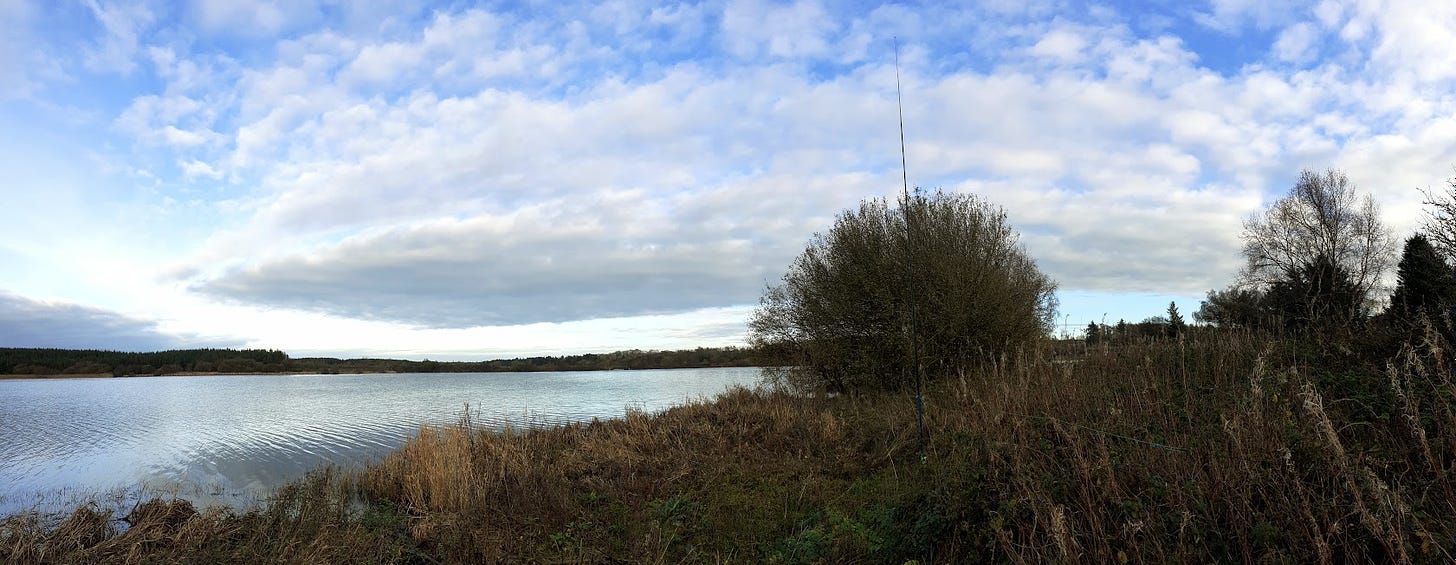
And now for the 20m results. Here, first of all, is the situation of the antenna:

The 20m vertical, operating also as MW6PYS. You can see just how calm it is!

The geographical reach looks like this:


Again, this is good performance, notably given that 20m is not such a spectacular band of late - something which is seen in just how many stations are using up to 5W output. Before I get too negative, let's look at the WSPR Rocks! ranking for the 20m beacons, see how I did in comparison to others:


What?  47th? Not so good!  Until we look carefully and see that, from the UK, I am actually the second best 200mW station. I believe that the best station, M0GUC, is using a Yagi (happy to be corrected).  The lakeside location, which has previously been shown to confer up to 10dB environmental gain over a terrestrial vertical, is thus shown again to be excellent.


Saturday, 10 December 2022

Marconi for Christmas?


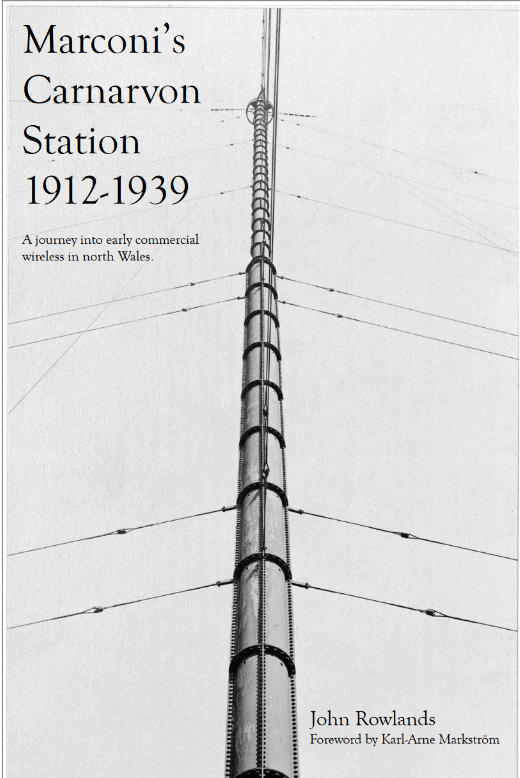
Well, it took five months and more work than I had ever anticipated. But the results is a nearly 200-page study of Marconi's Carnarvon transmitter site in north Wales.


You might think it too geographically-niche for where you are, but much of the station was replicated across the world, whilst certain elements were unique.

In the words of the Marconi Co. itself:

"The history of the Carnarvon station is, in large measure, the history of the Marconi Company’s work on high-power transmitters..."

You can buy a copy of my work, the first to use fieldwork and archive study to fully examine and understand this vast site in the 83 years since it was dismantled, using the PayPal smart button here - just £9.99 and available worldwide.

You will also receive a free, meticulously-prepared Google Earth-based plot of the features identified during the fieldwork, and how it all fitted together as a multi-antenna VLF site. 

The text and countless images are delivered as a PDF file; you will received a password to access the file after purchase.

Marconi MUU inverted-L transmitter site early in its life (1913, possibly before radiating wires had been installed).


Monday, 5 December 2022

Indoor Magloop vs. Lakeside Vertical

It’s not uncommon for most hams, at some point in their radio lives, to find themselves unable to erect an outdoor antenna. Most of us have neighbours who often seem increasingly intolerant of anything remotely out of the ordinary, and/or we may not have the space, anyway.

We had to move away last year from a QTH that we’d occupied for 13 years. It was a good place for radio, but not so good for family life, being distant from where most of us wanted to be.

So, temporarily finding ourselves in a less-than-ideal home radio location, I’ve sought to use magnetic loops. To be honest, so little interest do I have in our current property that I can’t be bothered even to begin setting up a loop outdoors. So I’ve hung a loop I alread had from the garage ceiling!

I realised many years ago, through experiments with loops in my timber decked, flat-roofed kitchen extension, that 60m and 30m radiation, particularly, travels well through that material with little loss.

Sure, the block walls and so on add to the overall performance degradation, but it’s not remotely as bad as we might imagine.

I’ve been running the loop, which is a square, 15mm copper pipe construction, about 1 metre on a side, at 10MHz WSPR for some time now. The results are surprisingly good; one day last week, my 5W signal got to Hawai’i at a healthy -17dB.

Now, 5W seems like a lot of power for WSPR. But we have to be realistic and make sure that a reasonable amount of power leaves the garage innards; it is, after all, surrounded by block walls, a large metal door, and all manner of disassembled antennas, waiting for better radio days ahead.

How well, then, would 5W from this indoor loop compare with 200mW sent from a tried-and-tested, elevated 1/4 wave vertical with two elevated radials, set-up at the local lakeside?

The lakeside location has much better ground conditions than practically all other antennas operating out there. In previous tests, the direction facing the water gave up to 10dB enhancement over an indentical antenna based on a low hill with a view of the sea, but not at the water’s edge. Typically, we can expect something around a 4-8dB benefit from fresh water locations.

Because of this good location, and the need to operate the antenna in the field on USB power, 200mW was considered a good power level to send. The data I present is from around 2.5 days, or 60 hours’ worth of operation.

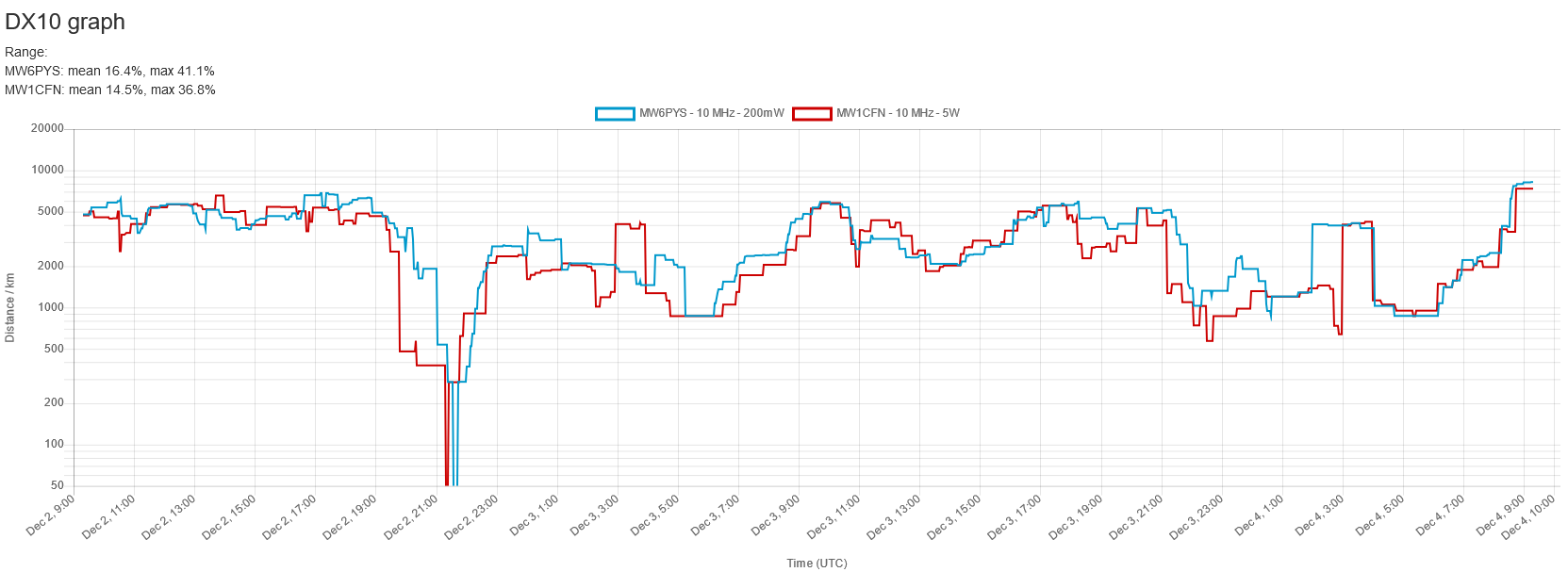
Using the analysis tools of SOTABeams’ DXPlorer, we can first compare the raw graph of geographical reach of the two antennas. MW6PYS is the vertical, MW1CFN the magloop:

By eye, we can already see that the two antennas are reaching very similar distances - remembering, of course, that we are using 14dB more power into the indor magloop to achieve this near-parity. The figures on the top left give a mean 16.4% (of the maximum distance attainable between two points on Earth) for the vertical, whilst the magloop comes in quite closely behind at 14.5%. In terms of maximums, the vertical gets 41.1% of the way round the planet, whilst the magloop managed 36.8% - again, not much of a difference.

This is what the physical reality of those lines looks like in terms of actual spots:

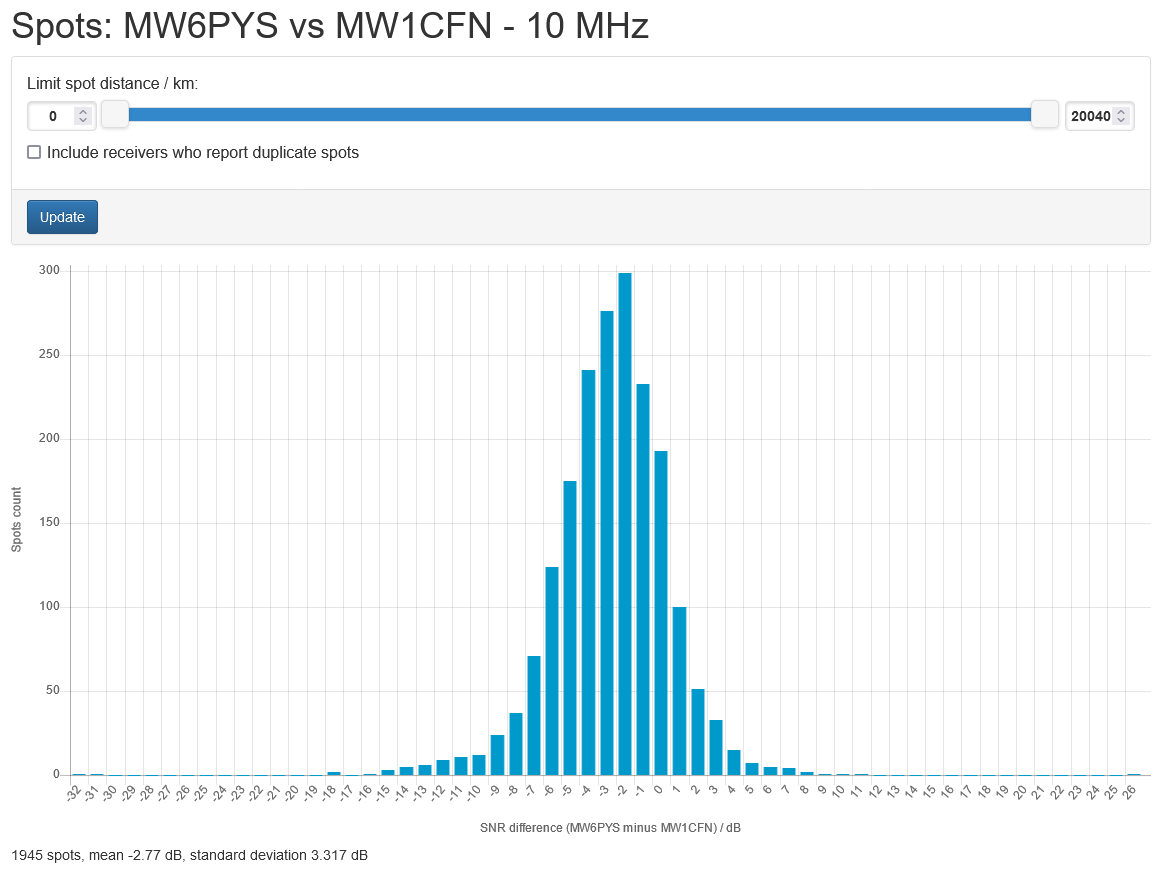
Most WSPR analysis you read stops there. But it’s not enough. Let’s look at how simultaneous spots - across all distances - compare:

It’s quite rare to see such a distribution in antenna comparisons. There are huge differences to some stations, both in the positive and negative directions, likely showing large differences in overall radiation pattern between the antennas.

The vertical comes in 2.8dB, in round terms, behind the magloop. Recalling we’re putting 14dB more power into the loop, and taking 2.8dB away from that, we get an absolute figure for the vertical of being 11.2dB stronger than the loop across all distances.

Even this plot hides important information, so let’s look at the performance beyond 5020km, or DX distances:

We now find the vertical come in at only 1.1dB behind the magloop, or an absolute difference of 12.9dB on DX paths (i.e. 14dB - 1.1dB).

Now, these are substantial performance differences. But we must recall that, being situated at the lakeside, which is not a location available to anyone other than the luckiest of operators, the vertical is ‘cheating’, benefiting from at least 4dB, and probably more like 8dB on DX paths.

This means that the true, power-normalised difference between the antennas, if located on a typical, non-watery location, is anything between 8.9db to as low as 4.9dB. This overall point is well-illustrated by comparison of the lakeside vertical with other United Kingdom 10MHz stations:

Comparison with G3OJI, showing the benefit of a watery ground. This result is typical across other UK beacons.

What does all this mean? It means that an indoor magnetic loop antenna, even where it is surrounded by metal, can perform at a level where you will obtain perfectly reasonable, global coverage with digital modes, using modest powers of only a few Watts.

SSB might be another matter altogether, but CW and things like FT8 can bring you the DX goods. If people went back to using things like OLIVIA, JT65 and JT9, then the wonderful sensitivity of those would make an indoor magloop and even better proposition. Sadly, though, those modes have fallen out of favour where they were, just a few years ago, the default modes.

And whilst we're here, we may as well make full use of the valuable WSPR data by looking at how well my freshwater site compared to G0PKT, who is near the sea in the SE of England:

Freshwater (blue) vs. seawater (red). As we already know from my earlier experiments, the coast offers substantial 'free' gain. Both antennas are verticals.
 

Finally, here's the list of top 10MHz WSPR beacons on 3/12/2022. The list is, rather stupidly, not renormalised according to power. But you can see MW6PYS (lakeside) is third in the list of global unique stations reached. Rather amazingly, MW1CFN, the indoor magloop, is pretty high up the list, too!


Wednesday, 27 July 2022

Still at work...

I thought I might do a little survey of Marconi's Caernarfon station for a couple of weeks, back in early May. 

Approaching the start of August, I'm still at it!

Some images, all (C) MW1CFN from the site:

A nice, almost chance discovery of a copper earthing strap, the only intact one yet found, on a concrete stay anchor.

Two footpads for a 60' per side self-supporing lattice mast. Two of these extended the first antenna by 900'
Part of a ladder, another part found downhill, which may well be a 400' length of ladder that ran inside mast 13, which collapsed in 1923 during construction. Another piece lies downhill.


A part of the collapsed mast 13. It was part of the tensioning system for the 400'-tall lattice tower. A tensioning rod is still attached, but buried in wet bog.


ALL IMAGES STRICTLY (C) MW1CFN, 2022.


Friday, 24 June 2022

Am I dead?

Output on the ol' blog is a bit slow these days. Well, there is plenty else to do, and radio sometimes has to take a back seat.

Added to that has been a survey I started, mostly out of personal curiosity, of the 1914-1939 Marconi VLF site at Cefn Du, near Caernarfon (then anglicised to 'Carnarvon').


Superficially, there is not much to see here these days. The transmitter and power buildings are still here and very identifiable forms reproduced at other contemporary Marconi stations, notably Stavanger.  Otherwise, there are just the concrete stay anchors to see.

A 2017 Marconi Day outing with the local club gave us a chance to look at the lower anchor blocks.
 

But, by walking slowly and carefully around, detail - a lot of detail - starts emerging. Consulting some books, internet archives of journals of the time and the Marconi archive itself, something much more like a complete picture has come together.

It's not been easy, and it's far from complete at the moment. The mountainside site is exposed and boggy in parts (wet sites were deliberately sought for Marconi stations - they believed this provided an "electrical connection to the sea"). In other parts, it's thigh-deep heather, making walking and finding things through it really very difficult indeed.

Footpads of a 400' (122m) high triangular mast for the 1924 antenna extension - and some 20m WSPR with SES callsign GB1MUU!

Sadly, due to copyright constraints, I can't yet show you any images, other than what is already in the public domain.

So, for now, here is a screengrab of what has developed into a complex plot of features on a Goole Earth Pro background. When it's finished, I'll be releasing the .KMZ file, so that it's easier to see and understand, together with some simplified plots to show particular features.


 The main features are:

(1) The first antenna, completed 1914, runs from the TX house at far left, the yellow circle and emergent yellow lines representing the (outer limit of) an earth screen system. This was buried around and beneath the antenna initially.

(2) The extension (later split to operate as a separate antenna) to the 1914 antenna, completed 1924, and running to the upper right.  The 1924 extension, running at an angle of 130 degrees to the 1914 antenna, is a tacit admission by Marconi that the inverted-L antenna was not directional in the manner he had long claimed - see contemporary field strength plot, more like a 2-element beam, below:


(3) The dark purple lines are the wires between lattice masts that supported an extensive, matched meshed-wire counterpoise. The full arrangement was too dense to be represented fully. Pink lines are trackway routes.

(4) Blockhouses around the perimeter of the site, which were manned by the military under fear of sabotage.

The pyramidal peak of Yr Wyddfa ('Snowdon') at right provides a beautiful backdrop for the Marconi MUU site. Even substantial structures are now beginning to be buried under moss, grass and heather.

Naturally, all content is strictly (C) MW1CFN, 2022.


Tuesday, 31 May 2022

Hard-headed, or just incompetent?

It's now three weeks since the RSGB sent an unsolicited e-mail to me due to, it claims, "malicious software" gaining control of Len Paget's RSGB e-mail account. There is no suggestion Paget acted improperly or even knew of the event.

Meanwhile, Twitter provides evidence of continuing IT problems at the RSGB, though no detail about what the "things" causing RSGB to be "extremely busy" is known.


In those three weeks, I've learned of, yes, the "malicious software" and that this somehow caused Len Paget's e-mail account to send what the RSGB termed "a phishing" attack, with an attachment. The RSGB further explained that, unless I had opened the attachment and entered details into it, there was no risk.

I did open the attachment (with active virus and malicious software protection enabled), and it did not appear to have any elements where data could be entered. Sure, opening it could have planted a virus, but there is no indication this happened.

So, the description of what was sent around by the "malicious software" doesn't really match what I found.  I asked the RSGB for an explanation.  I also asked them to explain why they claimed this event did not occur due to data processing by the RSGB when they, in the same e-mail, explained that it used old sent e-mail and/or stored contact addresses from Paget's account to do its dark work. 

The claim this event had nothing to do with the RSGB is simply unsutainable, and a surprising one for a data officer to make.

I also asked the RSGB to explain whether or not, in its view, my personal data, and possibly that of many others (I can't know this), was disclosed to a third party during the attack.

I sent that request for clarification to the General Manager of the RSGB. He has neither acknowledged nor answered it.

It's a real shame - but entirely predictable - that, when robustly challenged, the RSGB goes to ground.  I've since referred the case to the ICO; with no response, and the earlier information begging more questions than it answered, that is the only thing that can be done, at least for now.

I also asked the RSGB's Data Officer to erase all my personal data, as I have not been a member for many years, was not and hadn't been for some time in active contact with Paget about anything, and there was therefore no lawful reason to have held my data in the way the RSGB admitted it did.

Whilst the Data Officer acknowledged this and said "further information" on the process to be followed for erasure would be sent out, I haven't received any such details.

I've given the RSGB notice of my concerns about their failure to respond to any of the points of concern raised after their initial revelations, and that a further ICO referral will be made if this persists.

For now, it does rather appear that the RSGB's ability to comprehend, respond to and enforce secure data policies within its structure seems open to question. I hope that it addresses the issues at hand, rather than embark on some other kind of response.


Saturday, 14 May 2022

RSGB 'hacked'


A strange thing happened at the end of last week. Completely out of the blue, I received a short, cryptic message, indicated as from Len Paget's RSGB e-mail account. Paget is one of the RSGB directors. 

There is no suggestion that Paget acted improperly, and may not have known about the event.

Paget's apparent e-mail simply sent a very short pointer to an associated, .eml type attachment, seemingly about some project or other. 

Given that I haven't been a member of the RSGB for several years, I asked the GM to explain why they held my private e-mail address, and why I had been sent the e-mail, apparently by Paget.

All went eerily silent for a week, when I had to poke the RSGB for a response, saying I would have to refer the matter to the Information Commissioner's Office if they persisted in not acknowledging my request, which was a formal Subject Access Request at that point.

This prompted the revelation by the RSGB's data protection staff that they had suffered a "malicious software" attack. The details are far from clear, and I've asked for clarification - which hasn't yet been given, and so I cannot give the RSGB's full position at the time of writing. The following is the initial position:

'Our apologies for the recent unwanted email.  The email in question was sent as a result of malicious software which had gained access to a user’s email account, and did not result from data processing by the RSGB.

This week we have conducted a thorough security investigation into the incident to avoid any recurrence.

The malicious software made use of contacts and old sent emails on the affected user’s machine.

Analysis of the bogus emails sent out shows they were a phishing scam designed to collect user login data – unless you opened the attachment and followed the link and entered data it should represent no threat to your devices.  If you still have the email, or more subsequently arrived, you are advised to delete them.'

On the face of it, this could be a case of using/accessing RSGB e-mail accounts from home computers, which can be entirely legitimate - if there are data security measures in place and people follow them.

The claim that there was no "data processing by the RSGB" is a little specious, as they are the Data Controller, and have the legal liability for what happens with data they process - data which they admit Paget had on his RSGB account as "contacts and old sent emails on the affected user's machine". This is the GDPR definition of 'processing':

Whilst holding such data might well be legitimate, there is also the need to ensure data that is not needed is not kept longer than strictly necessary. As a non-member, and not in any ongoing contact with Paget, there seems to have been no justification to hold my data at the point it suffered this attack.


Given what has happened, there are real questions about the RSGB's security measures, and whether they are applied consistently - or at all - if people are acting on behalf of the society from home equipment or, indeed, RSGB office computers. This is all the more important, given the increased likelihood of attack due, for example, to the RSGB's stance on Russian participation in their events.

For now, it is entirely unclear how many people were affected, and where their data has been disclosed, if anywhere. If, as it appears, there has been a data breach, then the RSGB must inform the ICO. There is as yet no indication that they have done so. I've advised them that, if they don't approach this incident with a view to addressing it properly, I'll be advising the ICO myself.

Update: from a discussion over on Twitter, the RSGB yesterday (13/05/2022) asked users of their new portal to set up passwords. It is unknown whether this is related to the hack discussed in this blog post. The screengrabs from the RSGB website (accessed 14/05/2022) confirm problems with the portal: