I'm delighted that there's been a fair bit of interest in the cheap loop idea.
Perhaps the only real problem with loops is their extreme sensitivity to tuning - which of course is why they are also good for receiving, as they reject pretty much everything outside an incredibly narrow 'window', such as that depicted below:
Whilst a motorised tuning system is pretty easy to construct from cheap components, a manual system is more useful in the field, as there is no need for batteries.
But it can be tricky to hit the 'sweet spot' reliably, especially near the self-resonance point of a loop. A drive reduction system is desirable, if not essential.
So, I was happy to find this pretty vintage 10:1 reducer last week for about £14, not much more than the new, but far more basic and coarser 6:1 units you can find also on E-bay.
If you are going to get a reducer, keep in mind that the body of the drive has to be secured somehow, otherwise it has nothing to turn against. This is sometimes not so easy to arrange. This unit has holes through which it can easily be secured to a panel or frame if needed, but I found that, with the help of a single turn of self-amalgamating tape, it would fit neatly into a 22mm PVC pipe clip. Very simple, for once!
Latest 14MHz reception of VK3QN (long path-directed), showing a ~14 hour period now, with the strongest peak an hour or so before local solar noon, and a collapse commencing immediately after local solar noon (12:02UT on 19/11/2020), showing that the long and short path contribute to this near-noontime peak:
VK3QN 14MHz WSPR reception at MW1CFN, 19-20/11/2020.
UPDATE: Another long period of reception followed on 24-25/11/2020, with a much broader period of peak signal, which was 3dB stronger than the preceding example. Also a recovery after solar noon for a short period, before crashing into the noise:
I managed to get some time to read more of this month's Practical Wireless during the past evening.
On the cover is a picture of something that looks like the tail of a kite. It's actually an antenna wire sewn into some plastic fabric that slides over a telescopic fishing pole, making a multiband end-fed.
The review, which somehow manages to stretch to two pages, says that the sleeve design might help to make onlookers less suspicious of your radio activities.
Well, if putting up a 7m fishing pole isn't suspicious enough for the suspiciously-minded, then sticking a bright red sleeve over it (black also available(!)) is hardly going to make them turn away and go 'oh, it's just harmless radio, pour the wine, Donald'.
Of course, it gets worse.
Asking price for a (probably) 9:1 unun with a bit of wire and some material over it?
£125 if you want a pole with it. £95 if you don't.
Arrrrrrgghhhh!!!
A toroid for a 9:1 costs roughly £7 for a decent one. Maybe a couple of metres of enamelled wire for the windings, add another £3, maximum. Connectors? Well, those can be just auto spade types, costing almost nothing, and that we all have anyway. You don't need a plastic box over the unun, but it might set you back all of £3 if you really had to get one.
7m of wire: roughly £7, if you bought some decent kevlar-cored stuff that doesn't tangle. Most of us already have junk wire. Bantenna Man calls this 'feed wire', when it's actually the radiator. It's also the first time I've seen a radiator wire connector on the same side of the unun box as the coax connector - not such a good idea when the current maximum is as close as you could make it to the coax input.
Also note the use of a forked spade connector for the radiator. Anyone who has worked radio in the field will know these are generally a bad idea, because they easily work themselves loose when there is any mechanical movement going on (such as a wildly flapping fishing pole!) Don't copy this man: use ring connectors that can't pull themselves out.
Now the big cost: the telescopic pole, which have gone up substantially in price: now about £20.
Let's add all that up, and we get: £37. You can just tape, hang, or cable tie the wire to the pole. The sleeve idea seems to me, from the monumentally crap video (below), to be more of a headache than if it were not there.
You can in fact buy (if you want to buy anything) the same type of end-fed antenna from the Hawaii Emergency Radio Club for only a bit more - $56 - and, I can testify, is well worth considering for a basic, portable multiband solution, even if it's not the best antenna in the world.
What a total joke! £125 for a simple end-fed antenna. The only thing that Bantenna's owner should put a sleeve over is his microphone, because in his advertising video online, you hear more of the wind than his hot air about the antenna. The man also can't spell: "Imagine an antenna that hides in plain site [sic]".
Unsurprisingly, the owner tells us on his site: "We are not VAT registered, we don't have to be". That's because he doesn't (and probably never will) make enough money from his wire-in-a-sleeve to require VAT registration (currently £70,000 per annum).
OK. First the last few words about the 'John Loop', my poor man's homebrew of the £300 'Alex Loop' magnetic loop (coax cable) antenna.
With the loop still propped up against a chair in the kitchen, I sent 1W WSPR at 14MHz for a few hours. Whilst it was still just about working, I applied the tools of DXplorer to the results. They're pretty good.
Both these comparisons are with the stations who were reporting the largest number of spots from the UK, but both were using 5W, or 7dB more power than I was. All reports are for DX distances, in this case, beyond 4000km:
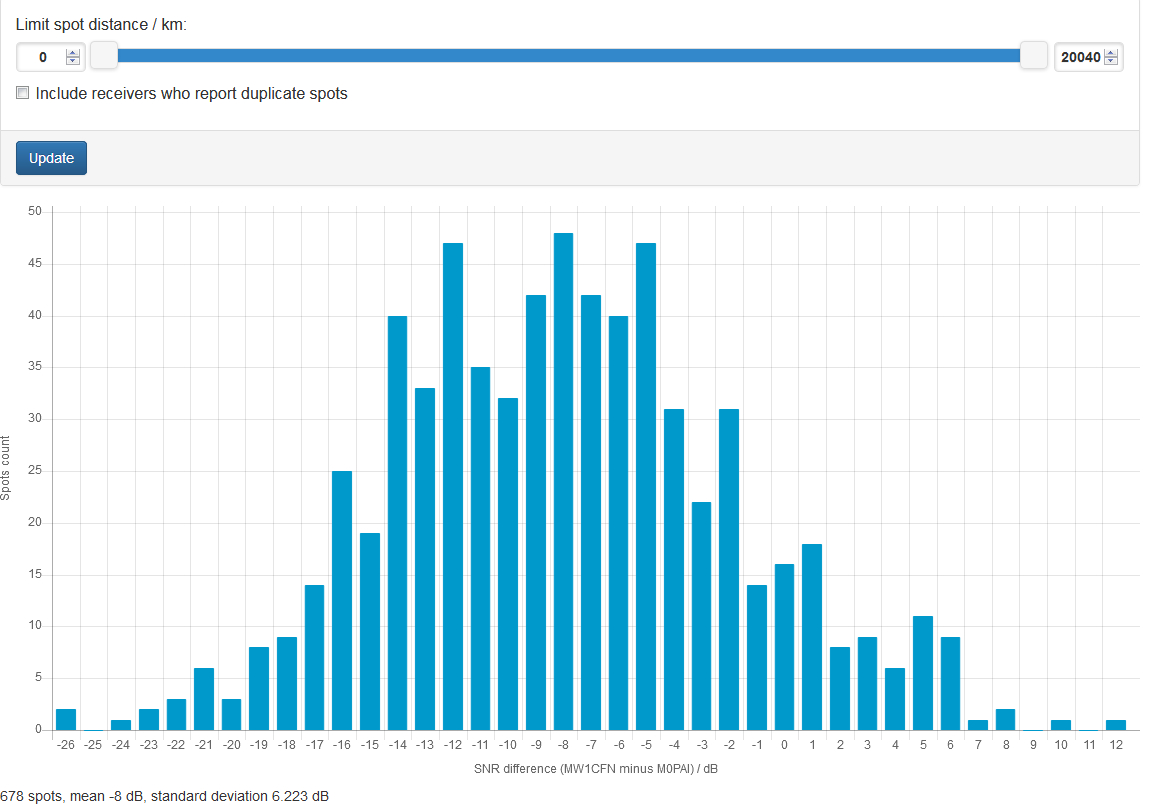
Here, I am 6.3dB worse than G4UGD, but he is using 7dB more power, hence I am ~1dB better at DX distances.
Against G0IDE, I am 3.6dB stronger at DX distances, despite using 7dB lower power. Hence, I am actually over 10dB stronger on a Watts-adjusted basis.
And good also against G8YPE, where the Watt-for-Watt comparison is ~3dB stronger at DX distances for my loop.
For those of you of a more gun-toting, Trump voting persuasion, remember that none of these results rely on any human involvement. I just built a coax loop, sat it in the kitchen, and let it do its thing, automatically.
And once we're finished? Just roll it up and stick it in a bag. The only thing to perfect is the support for field use. I'm thinking pipe clips of some sort to attach the capacitor to PVC tube, and maybe a ground spike. A tripod, the common solution, isn't really stable enough for windy places with such a top-heavy load.
It all rolls up into this small package. Ruler is 15cm. The capacitor has changed again, mostly because the vane contacts were easier to clean and maintain.
And for a floor-mounted, tidy version, have a look at this fine construction:
Thanks to the SOTABEAMS' WSPRlite 'matchbox' transmitters, WSPR use has grown a lot in recent years.
A useful feature of the WSPRlites is that, as a buyer of the units, you get to use 'premium' features of the software, DXplorer, which produces plots and comparisons of your data with others'.
Some months ago, I was told by the then managing Director of SOTABEAMS, Richard Newstead, that the company was no longer maintaining the DXplorer site.
DXplorer is useful for quick comparisons with others, although I was always a critic of the use of arithmetic mean for these particular calculations, something which SOTABEAMS refused to accept.
This week, with DXplorer taking a very long time to produce any output, and often simply returning a 'timeout' error with no output, I contacted SOTABEAMS to advise them of the problem, hoping that they might at least want to get the site back up and running properly, even if they no longer actively maintained it.
This time, under a new Managing Director, I was told that the company is in fact still maintaining the site, just "not as a high priority at the moment."
OK, these problems do occur, not least when they rely on the WSPRnet database, which itself can often hang up badly or completely - although that hasn't been the case for front-end users this week. And SOTABEAMS do seem to be willing to address the problem.
But I am a little uncomfortable with so many WSPRlites having been sold to the world, only for the seller to then see support for all the users of those products to be sent down the priority list, such that the site doesn't work, and needs us to prompt them to do something about it.
There is also a question as to what extent the advertising of WSPRlite units on the SOTABEAMS website might be said to be in breach of UK advertising rules. There is the clear association of the WSPRlites with 'premium' access to DXplorer, effectively meaning that buying a WSPRlite is also buying that access to the software. Put another way, if you don't buy a WSPRlite, you do not get that 'premium' access.
SOTABEAMS' website (accessed 08UT, 18/11/20) clearly shows it is marketing WSPRlites partly on the basis of full access to DXplorer - which it now says is a site of reduced maintenance priority.
If the software doesn't actually work, or is allowed to deteriorate without any attention being paid to it in reasonable time, then is that a breach of advertising rules? Only the Advertising Standards Authority are authorised to judge.
Certainly, it leaves a bit of a bitter taste in the mouth. Whilst we can do our own manual analyses of data, DXplorer certainly does - or did - make a huge improvment in the efficiency of those analyses. So its present moribund state is a cause of considerable disappointment, especially when SOTABEAMS has a good reputation of trust - on which I hope the new MD understands he really does depend.
The obvious solution to these kinds of problems, though less welcome, is to ask for a modest annual subscription for software use. This is something I've also argued should apply to WSPRnet, which has plenty of its own problems from time to time.
The other solution, which also gets around the problem of the ham community being dependent on proprietary software that might later be abandoned, is to make DXplorer and its ilk open source.
Well, it's been a true 'junk box' end to the week, when the increasingly rare leftovers from other projects have been recycled into an analogue of the 'Alex Loop' (£300) magnetic loop antenna.
The RG213 'junkbox' loop, proving definitively that solder and food do mix! Note the 'sausage' shaped primary loop, which also extends a bit outside the main loop. This gives the best coupling to the secondary loop, and is a form recommended by many experienced loop users over the years.
For the most part, this is an exercise again to show newcomers that magloops can be made very cheaply, are not as mysterious and impossible to build as some make out, and are effective solutions to multiband operation, needing hardly any physical space.
The leaning tower of Pisa is about 60m tall. A loop just 1m in diameter sends out waves that long!
Well, to test things out to the extreme, I located my magloop, made of RG213 cable, in the kitchen, and went 5W /QRP for real FT8 QSOs - on 60m!
As predicted, I did have to change the capacitor for a wider-space version (a Jackson Brothers 15-500pF unit). Tuning by hand at 60m is fairly easy and reliable, but gets progressively 'twitchier' as we go up the bands, and becomes impossible by 20m. This can be rectified with a simple PWM motor, or a different capacitor range.
New, wider-spaced capacitor. If you build a loop, don't space the SO239's as closely as I have here (I was in a rush to test the cap), because they affect system capacitance too much. Space them 10-15cm apart, and tuning will be a bit less 'twitchy'.
The first thing to note is that a magloop calculator, such as this one from 66 Pacific, will throw out an efficiency for this particular loop of about 3%. With 5W going in, this should mean my real output signal is a mere 150mW.
Is this calculation correct?
Almost certainly not. The reasons why are eloquently set out by Professor Mike Underhill, G3LHZ, in a chapter entitled The Truth About Loops in the International Antenna Collection book by the ARRL and RSGB. It is well worth a careful read, notably the parts about the persistent misinterpretation of the Chu-Wheeler criterion. Prof. Underhill concludes that, at lower frequencies, the conventionally-computed efficiencies (lower, very faint curve in plot, below) for magnetic loops are up to 30dB in error - something he terms "a scandal". A loop-related paper by Underhill can be found at Scribd.
Returning to my tests, I wouldn't say that QSOs are impossible at 60m with 150mW. But they might be very few, and weak.
This was most certainly not my experience this weekend!
For example, I was very happy to make a good QSO with my friend PE4BAS, who kindly then sent me a screengrab of the current reports:
For sure, I was very happy to see these kinds of reports from several locations across Europe, and I was effectively working a slow pileup on 60m for a long time on Saturday afternoon. The use of QRP power certainly seems to bring out the best in the radio community, with people making a genuine effort to support a low-power operation.
In the morning, I received a -15dB report from K1HTV, though he seemed to be only receiving at the time. I was also especially happy to make a QSO with TF3DT.
60m FT8 activity with my 5W and loop, past 24 hours.
There aren't so many international WSPRers on 60m, but the pattern (using 1W) reflects the FT8 activity:
I havent' enjoyed radio this much for a while. Operating on 60m ordinarily would need a dipole of 30m length, or a vertical of 15m. Those are not possible for many people. So getting on that band, let alone operating there effectively at QRP levels, from the kitchen, really is quite an achievement!
As winter deepens, attention always seems to turn here to magnetic loops, an antenna that I've always enjoyed good success with. As always, the key to that success is a good environment.
A very popular portable loop is the Alex Loop, made of Heliax-type coax. At 14MHz and above, this diameter of copper conductor is perfectly acceptable, and will have an efficiency of 90% or more.
I've never tried a coax cable loop, and I have absolutely no intention of paying £300 for one! I also never use the primary and secondary loop 'Faraday' system, because it is susceptible to mechanical shape changes and, hence, matching instability. But that's the system I will use for this experiment.
I don't have any Heliax, which is more than £5 per metre. So I am building my first protoype with plain RG213. If it doesn't work, I only need 3m of conductor for a loop, so we potentially face a bill of only ~£17 for that.
As for the matching capacitor, well it's not the building of the enclosure for that which represents the biggest problem, but finding a reasonably priced one on E-bay, where competition for these is always very strong, sometimes leading to silly prices. The plastic box was £5, and the large control knob £2.75. I already had the SO239 sockets.
Tuning capacitor. It's a deep box, so those wires are very well separated. Range ~25-450pF. Connections are to the outer of the SO239, as we only need to use the outer of the coax.
So, compromise again here, with a capacitor that is likely only to handle ~5W maximum before breakdown. But it will be fine for some WSPR RX and some TX as well. It has a modest reduction drive which, combined with the large diameter knob, makes fine control easier.
Innards of the Alex Loop, with the (many) added DC and reduction drive components. Maybe my plate spacing isn't too bad, after all!
This (French language) site is really good, and looks somewhat more professional than my attempt; lack of time never lets me make things especially pretty! At worst expenditure case, I think this would cost no more than about £50 - a saving of £250 over the commercial version!
Next step is to get some free waste timber from the local builders' yard, and put it all together. With more wind and rain on the horizon this weekend, this will while away the time nicely. Progress reports to come...