Wednesday, 11 November 2020

Reference quiet field reception - VK3QN

The geomagnetic field has again been dead quiet (Kp=0) over the past day, affording a useful opportunity to create a 14MHz reference WSPR reception curve for VK3QN, beaming 130 long path to Europe.

Dead quiet field.


14MHz reception of VK3QN, WSPR (5W).  TX: fixed 12 ele (130 degrees).  RX: vertical delta loop.

The first peak at around 06:30UT is when I have just emerged into the greyline, with VK3 still in afternoon daylight, and represents the longpath signal:

06:30UT  Image: DX Atlas, with permission.

The second peak about 09:00UT is when VK3 goes into his evening greyline.  Proppy HF shows that this situation is most likely to be a weakening long path signal, supplemented with a fair degree of shortpath leakage from the back of the beam:

09UT

The irregular, weakest peak at 11-12UT is now probably solely shortpath leakage from the rear of the large 12 element array.  At 12:40UT, the signal from VK3QN is lost altogether:

12UT


IC-705: a strange review.

This month's Practical Wireless features a review of the Icom IC-705.  The reviewer - G3UGF, an active participant and QSL bureau manager within the RSGB - awards the new rig a staggering 4.9 out of 5.

Or does he?

What the review text actually says, in terms, is that the robustness of the design - a crucially important aspect of a rig supposedy aimed at the, erm, portable market - is 4.7 out of 5.  

The overall, all-things-considered review rating awarded by the author is 4.8 out of 5. 

It is only "features and benefits" , "ease of use", etc, that are awarded 4.9 out of 5.

So PW maganzine has hand-picked the highest rating and printed that in a big star rating graphic on the strap page. 

OK, you might say that 94% (4.7/5) is not meaningfully different from 98% (4.9/5).  But I am not impressed with this picking-and-choosing of figures in a review, especially from PW.  It undermines confindence in reviews, when magazines in general (and not necessarily PW itself) already have to struggle with the desired objectiveness of product reviews and the need not to produce too many negative comments, in case they affect advertising potential.  

Consider, for example, the following, quite astonishingly silly statement in the closing words of the IC-705 review:

"There's no pretence of being rugged, but I appreciate that's not its marketplace."

What?

This flies completely in the face of reason - and ICOM's advertising.  It's a small, portable transceiver that has been accompanied by a lot of 'outdoors scenes' advertising, including promotion of a (very expensive) backpack, designed specifically for the IC-705.  Very early pre-release advertising images prominently feature the words "Be Active", and a man (of course) in hiking gear.

If a timber log and the words "Be Active" make this rig's home anywhere but the outdoors, where would that be?  Image: ICOM.

If the IC-705 being used as a field-portable rig is "not its marketplace", pray tell, what is its marketplace?  

OK, QRP people may be interested for home use, and the HF/VHF/UHF coverage will attract some more.  The promise of an amplifier may sway others.

But I don't think that many would actively choose the IC-705 for anything other than portable use as its main role, perhaps with a bit of home use thrown in on occasion.

If you're going to take a piece of sophisticated electronics like the IC-705 out into the outdoors, it really had better be built for coping with dust, sand, moisture (if not heavy rain), and lots of being knocked around.  Especially at £1300.

So how does G3UGF conclude that this rig has little or no ruggedness for the outdoors, yet awards it a 94% rating for the same general aspect, despite saying explicitly that the main reason for knocking back the rating is the lack of a pop-up stand?  To me, at least, it's an irreconcilable mystery.

I already had the idea, from quite a few comments online about the lack of environmental protections, that the IC-705 was not a rig for me, or many other portable users.  Now I am certain of it.

It should also be highlighted that G3UGF awards his very high score for this rig without touching, so far as I can see, digital mode operation.  Given that digimodes make up the overwhelming bulk of activity on the ham bands now, this is a very peculiar and serious omission.  G3UGF is getting on in years, and, his QRZ.com entry says, spent his professional life in radio communications.  These things do, I'm afraid, lead you to become rather stuck in one's ways and not realise what 'youngsters' are up to these days.

If I had to buy a portable transceiver this morning, I would opt for the (same price) tried-and-tested KX-3, even though it, too, is said not to be very protected against the elements.  If it were available from a UK seller who could observe consumer protection laws if something went wrong, I would choose the (half the price) Lab 599 TX-500, which is built in the true spirit of Russian robustness and real outdoors conditions.


Tuesday, 10 November 2020

14MHz Rhombic - a failure?

Full of enthusiasm from early experiments with a vertical rhombic, I set out with my shiny new yellow wire for 14MHz this morning.     

Rhombics are large antennas, and so I decided that I could not realistically deploy a wire more than 2 wavelengths long in the air.  This was partly due to controlling safety on a public beach (if you want to do the same thing, join EURAO and get their public liability insurance), and partly  because the wire has such a shallow angle at longer wire lengths that it ceases to function as a rhombic.


So, up went the 42 metres of wire, connections to earth made at each end, via a terminating resistor at the beaming end, which was pointing about 035 degrees.

Well, the results were pretty poor.  Whilst my 1W did get across to JA3APN, ZL2BCI and VK4CT when my vertical delta at home wasn't at all, comparisons with others in the UK, even taking longitude effects into account, showed that the rhombic was not very effective.  Taking into account the known enhancement available from the beach - typically 8-14dB - the rhombic was probably performing below that of the best UK wire WSPR antennas.

I did take along an RF meter this time,  which showed that the azimuthal pattern is very narrow - much narrower than models suggest, and only a few degrees wide.

Propagation conditions were tricky with this test, with enormous, presumably real short period variations, as the plot of SM2IAR's reception of my signal (this station was within the narrow beam of my antenna).  The geomagnetic field was extremely quiet (KP ~0), and had been for the preceding day:

14MHz reception of my 1W WSPR by SM2IAR.  TX frequency for the delta was lower than for the rhombic.

I won't bore you with a full analysis this time, because it's clear, even from a cursory look, that this antenna doesn't cut the mustard, at least at 14MHz and a 2-wavelength wire length.  It is a fairly easy antenna to put up, taking no more than a couple of minutes.  But that time is far better spent on putting up an even easier-to-erect 1/4 wave elevated vertical, which we already know will beat the socks off everybody else from the beach.

There was, though, a reasonable result - but almost certainly no better than a 1/4 wave vertical would have achieved - in my signal to OH3FR:

14MHz 1W WSPR received at OH3FR

I still think it's an antenna worth testing again at higher HF, because of the multiple wavelengths that then come into play with this same kind of wire length.  But that will have to wait for another day...


Monday, 9 November 2020

Modelling the vertical rhombic

Still getting software back up and running on the new PC at the moment, with MMANA-GAL the latest to be restored.

Usefully, the software comes with a ready-made model of a rhombic for the 10m band.  Somewhat unusually, it consists of legs each 0.75 wavelength long (so each half of the antenna has wires 1.5 lambda long).

To model my own antenna, all I have to do is rotate 90 degrees about the X axis to create a vertical antenna.  Over near-perfect ground at HF that is found at the coast, this is a very satisfactory approximation to what I can expect in reality.

Here's the surprising output, totalling over 12dBi gain, which seems a lot higher than we might expect, although ground settings are set to perfect:


The horizontal beamwidth is remarkable!  No need to worry about lack of geographical coverage with this antenna (which, it should be noted, is an unterminated version; the terminated version should see half the pattern more-or-less vanish).

This is all rather encouraging for a 14MHz version, where it seems unnecessary to make an enormously long antenna to realise excellent gain figures.  New roll of wire awaited with enthusiasm!


Sunday, 8 November 2020

Some more VK3 reception.

More for my records than of any real interest to others, a report on VK3MO and VK3QN 14MHz WSPR reception 06-07 November 2020 under Kp~2 conditions.  Both stations are large Yagi arrays.

With VK3MO turned from LP to SP at the time the long path was weakening rapidly, we can - briefly - see the nice contributions from each path, given that VK3QN is a fixed long path to Europe array (beaming 130 degrees):

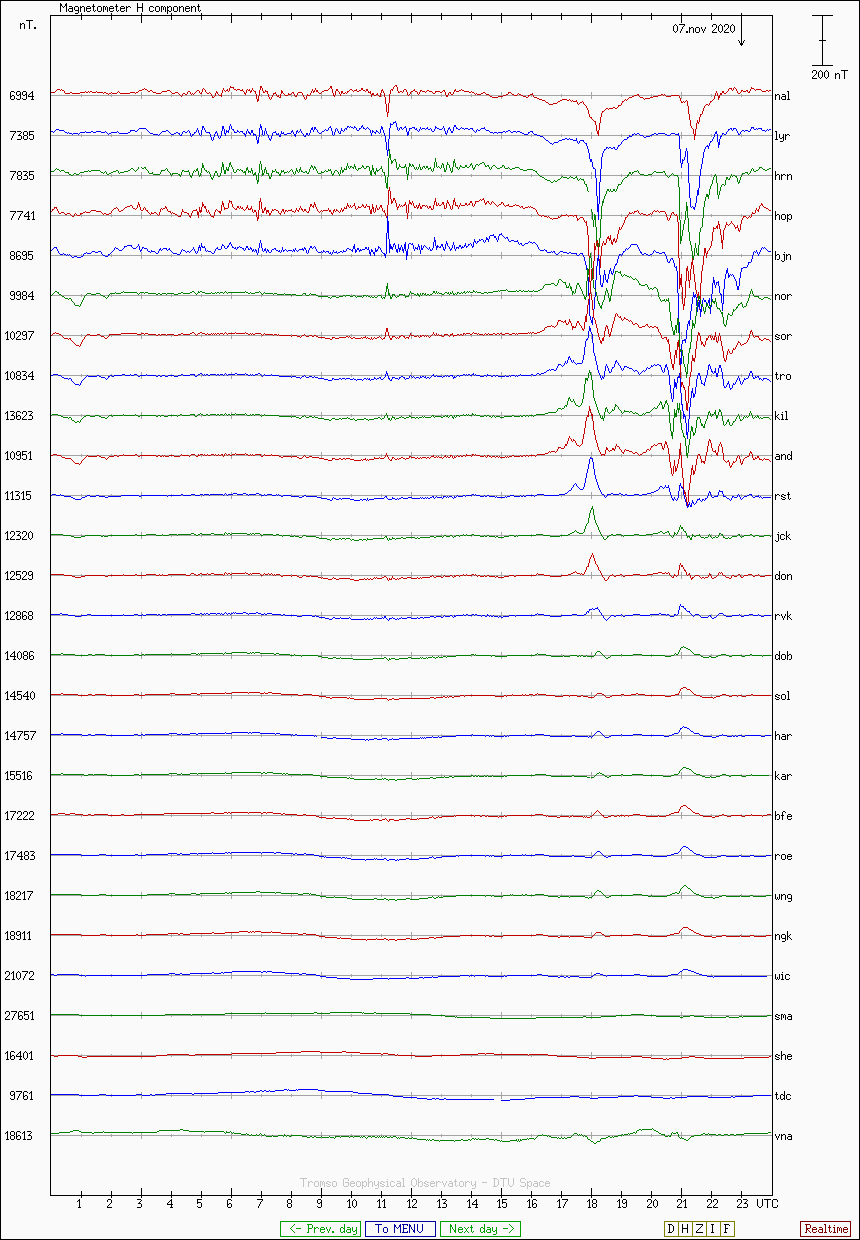
14MHz receptions of 06-07 November (labelled '07') and 07-08 November (labelled '08') are plotted below, showing the significant variations in signal, despite the geomagentic conditions being broadly similar on both days, except for what are obviously important field differences in varition at very high latitudes:


H component field variation 06-07/11/2020.  TGO, Norwegian line.

H component field variation, 07-08/11/2020.  TGO, Norwegian line.


HFTA Software - Virus!

The ARRL's HFTA software, included on a CD packaged with the Antenna Handbook, is an important and very useful tool that I've used extensively over the past few years, even with my predisposition towards vertical antennas, which HFTA can't handle.

But yesterday, when installing it again from a 22nd Edition CD on my new PC, Windows Defender found a serious virus on the CD that means I can no longer run HFTA (or any of the CD, actually).  The virus was never identified during previous installations under Windows 7, even when I had good quality payware virus protection.

The virus in question is a Trojan: Win32/Vigorf.A, which apparently allows hackers to control your machine remotely and, of course, steal your data.

Whilst Windows Defender can effectively remove this virus, you should be aware of this serious risk and at least avoid installing software from older versions of the Antenna Handbook discs.  I don't know if the ARRL are aware of this problem, or whether the latest editions are virus-free.


Thursday, 5 November 2020

Half rhombic deployment: good results.

A very calm day started early this morning for me at 05:30UT, when I took to the still dark coast to see how well a simple half-rhombic would perform.

Here's how it looked later in the morning:

The eastern (beaming direction) end was grounded via a terminating resistor:

The 'missing side' of the feed was also grounded (see below). A good background to this antenna is found here.  There's also a lot of useful modelling (treat with caution) here, though the comparisons with stacked Yagis for 40m is, well, typically American and utterly impractical, next to a simple wire.  Try putting up stacked 40m Yagis up on your own, on a beach, in the rain...

The feedline is 300 Ohm twin going back to a 4:1 balun, and a very short piece of coax from that to the transceiver.  This is a standard, ultra-low line loss, multiband arrangement I've used over many years for a multitude of different wire antennas:


Did it match up?  Well, I sat there, feeling a bit dejected when it wouldn't match on anything other than 12m.  The key fact is how early I got up - and how being tired led me to miss that the TS480 selector was on 'Ant 2' for every band except 12m, when the antenna was connected to 'Ant 1'!

With brain re-engaged, I found the antenna could be easily matched on all bands from 160m to 6m.  This is quite typical of grounded antennas like this. Remember, as you read the following, I did not at all plan to use this antenna below 17m, so this is all a bonus.

Time is, of course, the enemy in making antenna tests. Starting with just a very few minutes' work at 80m, even though it was well into daylight, I was not getting out very far at all, but the receive was quite surprising for the time of day:

Just a couple of TX/RX cycles at 80m WSPR (1W).  Two US stations, even in daylight.

I then went straight into 17m WSPR work.  This was hopeless, because there are now practically no WSPR stations active on that band.  The best I could do, which can't be relied on, is a path along the beam direction to Russia giving 10dB better than my 17m delta loop at home.  It's just one spot, and the sea gives that kind of gain anyway.  So the rest of the antenna assessment is, for now, largely subjective.

Changing to 17m FT8 (10 Watts), the results were encouraging.  The band was usable very early on indeed, much earlier than if I were at home, and good DX from Asiatic Russia, Japan and VK kept coming in at good signal levels.  QSOs as far as Asiatic Russia were made:

17m results, FT8.

On 15m, the signals were very strong, and had all the feel of operating something like a 3 or 4-ele beam.  I didn't bother with WSPR, but FT8 got as far as VK.  Difficult, due to the bias of the time of day, to say how directional the antenna is at this wavelength, but it does seem to be at least reasonably narrowly-focussed:

15m results, FT8.

On 12m, it was again like using a beam, and the directionality was significantly sharper, with the strongest SNR reports falling in a very narrow 'corridor', which you can easily extract from the plot below.  

When I cross-checked with the 3-ele back home, the 12m band was clearly in quite poor shape, and so the results I got from the beach do seem to represent a very significant improvement on the Yagi, perhaps equivalent to a 5 element or more.  I even made a number of DX QSOs as far as Western Siberia from the beach.  From home, all my 'CQ' calls went unanswered, and the only two signals I could hear were very much weaker than at the beach:

12m results, FT8

In carting a load of stuff to the beach, I forgot the antenna analyser.  Even so, the approximate SWR figures, as given by the transceiver, were as follows (at the end of 300 Ohm twin and a 4:1 balun).  Remember that, with twin wire, line losses at even very high SWR are negligible, at only a small fraction of a dB.  All these bands matched easily and quickly with the TS480's internal tuner:

160m: 3:1

80m: 1.3:1

60m: didn't measure!

40m: 1.3:1

30m: 1:1

20m: 1.7:1

17m: 3:1

15m: 1:1

12m: 1.3:1 

10m: 1.7:1

6m: 1.4:1


So, is this an antenna worth continuing tests with?  After some thought, I concluded that it is - even though most texts give a terminated rhombic an efficiency of somewhat less than 50% (but this isn't really a good way to judge an antenna, especially down at the beach). 

Firstly, it's a true single-wire, all-band antenna.  It probably doesn't give a super-effective signal out on the lower bands, but then, it's always better than not having any access to those bands.  Receive on those bands seems to be exceptionally good, subject to further testing.

Secondly, it is easy to put up.  The most difficult thing is getting a sturdy enough support for your central pole.  I used, for the first time this outing, a 90-degree angle iron hammered into the ground (with wood, to avoid mushrooming the metal), which went into the ground very easily, and gave more than adequate support for stong winds.  I plan to weld small side steps so that I can simply stand on it to drive it into the ground, rather than hammer it.

Very simple, cheap 10m pole support.  90 -degree steel, with a sharp spike cut into the bottom.


Thirdly, the antenna will tolerate high winds easily when the wind is perpendicular to the wire beaming direction.  When it is along the wire direction, the central support will bend a lot, and stress the upwind wire.  This is not a problem, so long as you use something like kevlar-cored wire, which can take the load easily.

Finally, the first, admittedly not very complete testing shows that, especially from 17m up, this is likely to be a very good, directional antenna, especially when used near watery situations.

The next step is to make a version with its focus on the 14MHz band.  That will make comparisons with past data, and new data yet to be gathered, much simpler.  Wire is already on order!

Again, it was very nice to be approached by a number of people, interested to know what I was doing.  I even seem to have informed them in a way they liked!  Meanwhile, the UK's newest polar research vessel 'Boaty McBoatface' (actually the Sir David Attenborough), was undergoing its first sea trials just offshore from my antenna!

The RRS Sir David Attenborough, named in a popular vote as 'Boaty McBoatface', leaving Liverpool some days ago for the Irish Sea trials.