Tuesday, 7 February 2017

WSPRlite 200mW - The Results

This is more a diary entry for my records than anything of interest to readers, but it might be of use, nonetheless.

For just under a week, I've run WSPRlite at 200mW output into a vertical delta loop antenna, fed by 300 Ohm twin via a 6:1 balun.

The comparison station - G7CKX - has been chosen as one of the best-heard by others, and running the same power as me.  I've carefully gone through many stations and contacted operators about antenna details.  It's clear that the overall pattern shown by the comparison station is entirely representative of what all other stations running the same power with simple antennas showed.  In some cases, my antenna matched the distances achieved by others running up to 5W (a 14dB greater output.)


The first obvious difference is that, in this case and for all others consulted, there is a considerable difference, in my favour, in both average (+6.4% of possible) and maximum (+10.3% of maximum) distances reached.

Secondly, it's clear that my vertical loop acts in an extremely consistent way from day to day.  There's a sharp rise as the ionosphere is lit, a small step in the morning, and then a steep climb to a very steady peak distance for some hours prior to the band closing even more sharply in the mid-evening (February 2017).

The other antenna, which seems characteristic of a dipole, shows distinct peaks and troughs which are not present in my vertical antenna.  This probably reflects the directionality of a dipole, and may also highlight some elevation pattern changes, evident as the day progresses.

What is clear is that my delta loop performs very well indeed and, at last, I have some objective data with which to back this claim up.  The overwhelmingly important factors are a superb ground (an old copper mine) and an undeveloped, elevated position overlooking the sea. 

The real lesson for others reading this is: don't necessarily accept what others tell you about how and why antennas perform.  Exactly what you will get out of any given antenna depends very critically on the environment - something that the majority of urban-prone operators simply fail - and often refuse - to accept.

For interest, this is the plot of people hearing both stations mentioned above:

MW1CFN (blue), G7CKX (red), both (green)  Apologies to the colour 'blind'!

Monday, 6 February 2017

VHF Contest Rules - A Petition.

Please sign this petition, set up by G8LZE (David Dix) in support of a review of VHF contesting rules set by the RSGB, as soon as you can.


Saturday, 4 February 2017

RSGB VHF Contest Rules, Contested.

This is a response from David Dix, who is leading a campaign to challenge recent RSGB changes to VHF contest rules:

Picking up trouble. Image: KB5WIA.


"Until this year the scoring system for RSGB UKAC contests was based on a “multiplier” system where each new main QRA square, ie. IO82, gave a multiplier of 2 to the points per kilometre, PPK, score. So a station making 20 complete QSO with a sum total distance of 3600km with stations in 5 different QRA squares gave a total contest score of 3600 x 5 x 2 = 36000 points.

Some stations on the periphery of the UK, felt they were disadvantaged under this system, so the RSGB VHF contest committee tried to originate a scoring system that would "level the playing field" this despite the 2015 RSGB Presidential Review of contesting final document concluding:-

"It is difficult to achieve fairness across the UK and there is a danger of adding to the complexity of the scoring system. A practical approach is to do the right thing for the bulk of the population at the same time as taking all reasonable steps to eliminate bias."

The proposed revised scoring system, B2, is based on the same PPK but different QRA squares attract a one off bonus for the first station worked in that square. Colour coding of QRA squares gave red squares a bonus of 2000 points, green squares 1000 points and blue squares 500. Generally speaking red squares are Scottish, green squares cover northern England while blue squares cover southern England and east anglia.

VHFCC did much computer modelling and declared the new B2 system fairer however many regular contesters did not agree and warned that the system would skew results as the data used was averaged and hid a number of anomalies.

Despite these representations and more people in a consultation not voting for the introduction of B2 it was introduced in January 2017 and already the skew of results is clear. Just as an example:- in the 23cms contest on 17th January a Scottish station made just 5 QSO's with a total distance of 353 km but accrued 6000 bonus points giving a total of 6353 points. He beat the next station in the results table who was in England made 26 QSO's with a total distance of 2444 km but only 3000 bonus points giving a total of 5444 points.

This clearly demonstrates that rather than “levelling the playing field” the reverse has, in fact, occurred.

Much analysis is available at http://vhfgroup.co.uk/ which compares the different scoring systems derived from actual contest open logs.

What became clear when looking into the process is that no VHFCC meeting minutes had been published in breach of the RSGB's own bye-laws (now published) retrospectively but their accuracy is questionable as the March 2016 minutes carry the footer from the November 2016 minutes.

The whole operation of VHFCC and it's “consultation” was far from transparent or responsive, as required by the RSGB's own code of conduct, and some key questions still remain unanswered despite representations to the main RSGB Board whose governance during this period is also open to question.

This lack of transparency and active communication with members has resulted in bad feeling that a set of rules has been foisted on the VHF/UHF contesting community, despite a majority having voted against them, and has bred an atmosphere of distrust and the circulation of many conspiracy theories.

A possible light at the end of the tunnel is that the current RSGB President, Nick Henwood G3RWF, has announced a review of the 2015 review which may provide an opportunity to rectify some of the irregularities.

The aim of the petition https://www.change.org/p/david-g8lze-help-improve-vhf-uhf-contesting-in-the-uk is to try and get 300 signatures by 24th February which may well open the door for a discussion at the forthcoming AGM in April."

Monday, 30 January 2017

Les Moxon, G6XN

Recently, through e-mail exchanges with a colleague who knew Les Moxon well, I came to be passed a copy of his son's words at Les's funeral in 2004.

Credited to the RSGB at the originating linked URL.


As Les was a giant in mid-20th century radio, and continues to be very well-known to even the most casual ham today, I think it's important these words are recorded online.  Clicking on the images will render them readable. 


DXPlorer Insights

I've recently been playing with the fabulous WSPRlite mini-transmitter on 40m, made and sold by SOTABeams.

My antenna is hardly world-class in terms of design.  Just a 1/4 wave for 40m hanging off and fed against my 6m-high tower with a 12m Yagi on top. It was a throw-up job one day that proved to be a really good antenna.  More importantly, it's entirely hurricane-resistant - a major consideration up here.

Whilst the set-up is modest, it turns out to be perfect for this elevated position overlooking the Irish Sea.  The ARRL's HFTA terrain analysis tool shows that low horizontal antennas are in fact preferable at this location, due to the steeply sloping ground profile affording considerable gain, especially towards the western hemisphere of the local, sea horizon.  For example, peak gain for a 20m horizontal dipole at 2 degrees elevation arises at a dipole height of just 3m. 

The associated, DXPlorer web-based analysis tool, which is also sold (for £19.95 per year) on a subscription basis by SOTABeams, is an easy way to look in detail at what happens to your transmitted signal with time.  More importantly still, it allows you to easily compare your graph of spots against any other operator on the same band.

Already, DXPlorer is allowing me to prove what I've known for years - that my QTH permits access to extremely low angles, and that this gives rise to some outstanding DX performance.  This is especially so when the ground is extremely highly mineralised (it's an old copper mine!)

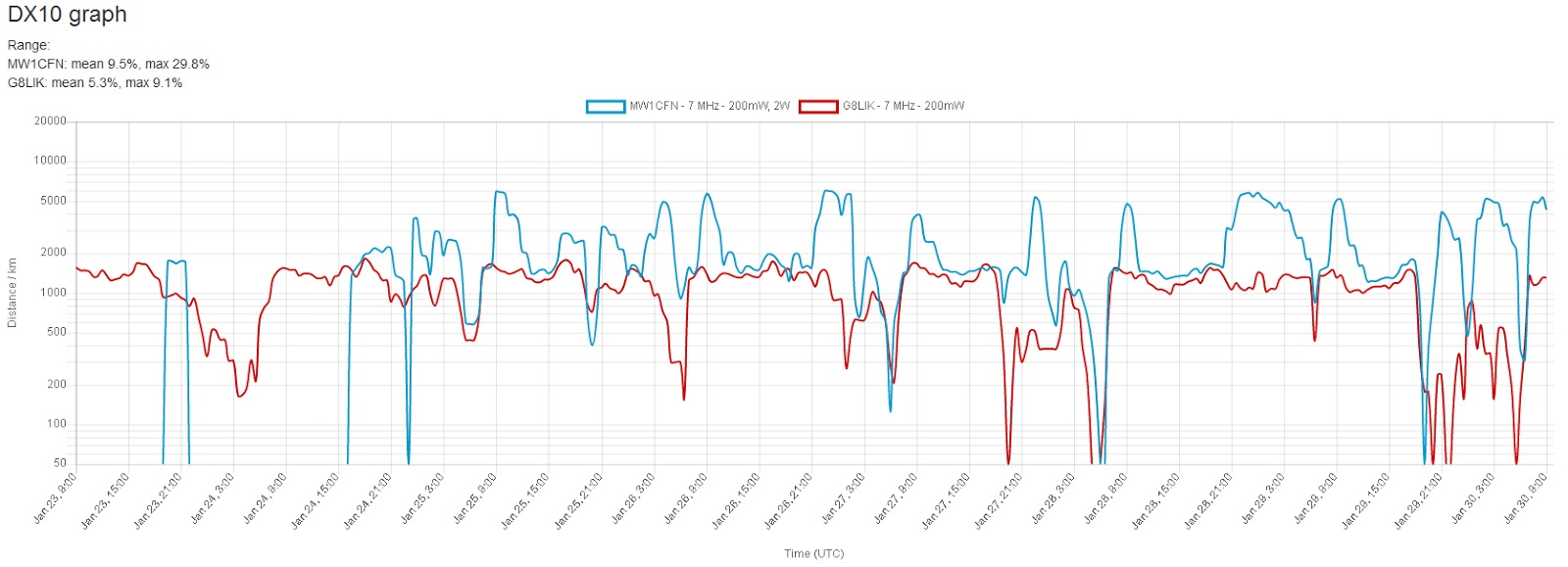
Here's the latest output for 200mW on 40m over about 5 days.  I've chosen G8LIK because he gets a very high number of spots and appears to have a reasonably open aspect, free of too much development around his antenna. 


If we take a slice of just one day through that data, we can see in more detail what's going on.


On the left hand side of the 1-day plot, which tends to repeat every day, is near-identical performance, with me slightly ahead in terms of reported distance, during the late morning, afternoon and into the early evening (ca. 19:00UT). 

From early evening onwards, things change very dramatically indeed. By 21:00UT, G8LIK is reporting only receiving stations within a couple of hundred kilometres, whilst I'm being heard across the Atlantic.

Around midnight, our two stations are more or less equal for an hour or so.  From then until 06:20UT, G8LIK drops away to being heard only by local stations, whilst I continue to be heard across the Atlantic throughout the early morning hours.

There's then a huge departure again between about 08:00 and 10:30 UT, where distances for me are about 5 times better than the other station, before we both come more or less together again for the later morning.

Whilst there are occasional differences in the detail, the general picture is quite steadily repeated each day, and is much the same when the comparison is with other stations.  Here, for example, is another well-spotted station, M0VGA:


I should point out, for those of a more gung-ho attitude, that I have chosen these two stations for comparison not in order to denigrate them, but because they are amongst the best 40m WSPR stations around.  It's clear that my results are not the result of some incredible knowledge or ability, but the result of a well-made and well-chosen antenna, installed at a very good location with exceptional, bordering on unique ground.

I'm very grateful for WSPRlite and DXPlorer, because when I come to put this place on the market, I will be able to objectively back-up my claims that this is a QTH worth having.


Tuesday, 17 January 2017

WSPRlite Arrival!

Well, I guess most people who are into WSPR mode will now know of the fabulous little 'matchbox' WSPRlite transmitter by SOTABeams.  For £64 delievered, this is probably the cheapest start to the radio year one can hope for!

It's also a really useful way to start 2017, because WSPRlite, apart from an initial and simple set-up, is entirely free of both a need for a computer or mains power.

Power (red USB) and an SMA male to SO239 is all you need to connect and transmit!  Image: K5ACL.


Delivering up to 200mW output, WSPRlite can comfortably run for a day or more on the cheapest USB charging battery stick (in my case, a 2.1Ah unit).

The real beauty of this system, of course, is the ability to take any antenna you like out into the field, perhaps building large ones that you couldn't accommodate in your garden, and set it up for transmitting WSPR to the world.  You only have the antenna, a short piece of transmission line, and the WSPRlite box.

I had a great time down at a local beach yesterday, comparing a 1/4 wave vertical at the water's edge with one back home, on top of a hill. Because WSPRlite is so small, it was easily protected in a simple rucksack from the rather damp conditions.  I didn't have enough time to draw any real conclusions, but on the last transmission 100mW from the beach was heard in DM25, a distance of over 5000 miles.

No more big transceivers and heavy batteries.  Just a tiny power pack and my lovely WSPRlite unit, down the beach.


There are a few videos online about WSPRlite, none of which are particularly scintillating.  Rest assured that you only need to download the software, and also the drivers.  My ageing Win 7 machine found and installed the drivers without any problem.  Programming the unit is even simpler.  An update to the configuration file was released 17/1/2017 due to the author discovering the randomised frequency selection wasn't working as intended.

WSPR operating /P from Parys Mountain - in the fog!

Just press the WSPRlite's button at 2 seconds past an even minute, as indicated by a reliable time service (mobile phones are almost always off by a second or more, and most can't be corrected, so a radio-controlled watch or clock is better) and off you go!  It might be an idea in future for some kind of atomic time receiver to be integrated into the transmitter.  But, as it stands, pressing a button is just fine and probably a good solution, all things considered.

If you're wondering whether or not to get one, do!

Wednesday, 11 January 2017

Shut Up and Transmit!

If you're fairly new to amateur radio - or even if you're not - then it's a fair bet that you'll spend a lot of time surfing the internet and reading books with titles like '600 More Vertical Antennas for Attics'.

What always happens with looking around for advice and tips on antennas is: total contradiction.  This leads to a feeling of frustration.  One guy will tell you his magnetic loop bust an antipodan pile-up on 5W, whilst others will happily argue for their entire given lifetimes that magnetic loops only emit feeder radiation (which isn't true, by the way!)

Now, the title of today's post is inspired by those who work on quantum physics.  Whilst the maths is worked out fairly nicely, nobody understands what quantum physics tells us about the true nature of reality.  A very recent survey found most still hang on to ideas formulated in the 1920s and that are almost certainly wrong. 

As a result, some physicists decided to tell others to stop pondering over the interpretation of quantum events, and simply 'shut up and calculate!' 

So, 'shut up and transmit!' is not a bad conclusion for us ham radio people.  I started out with little knowledge and therefore even less prejudice about what would - and what wouldn't - work as a good antenna.  As a result, I think in some ways, I have a better idea about antennas than those who figure out ways to spend ever more money on ever bigger towers, multi-element arrays, and those terrible things called amplifiers.

Here are my pearls of semi-wisdom after some years of keeping it simple:

(1) You have to work really hard to find sensible, objective views about antennas.  This is as true of printed books as it is of the internet and its endless bun-fights.

(2) It's the environment, stupid!  Stick a vertical in a housing complex, and it will probably work infinitely worse than if you stuck it in a n open field atop a rural hillside overlooking the sea.  If you realise that the most ham operators are based in highly-urbanised western nations, then most of those people saying that verticals 'radiate poorly in all directions' are almost certainly basing their simplistic - and wrong - opinion on their limited experience of trying to get radio waves through dense brick and concrete.  The nature of your ground is also hugely important.  Not all of us live on dry, sandy desert soils!

(3) An antenna does not need to be hundreds of feet in the air, nor does it have to have a 1:1 match.  At low frequencies, especially when using twin line feeder rather than coax, line losses in imperfect antenna systems are utterly insignificant.  If you have an open environment, and especially if there is some somewhat higher ground available, then a low antenna can work just as well - or even better than - an antenna placed much higher up.  A simple horizontal or sloper from my QTH shows the best low angle gain (which is very high) when a dipole is as low as 10 feet off the ground.  Almost everybody will shout at you that this is impossible and stupid.  But it isn't.

(4) What works for you is what works for you.  You aren't setting up a station for someone else.  Whilst some might dismiss digital modes as somehow not really radio as they think of it, the fact is that digimodes have opened up the world of DX to those of us who have less than £50,000 to spend on equipment, and a garden that's less than 100 acres in size.  Simple and less-than-ideal antennas will bring in the DX, believe me!

(5) Work the long path!  When the terminator lines up between you and an interesting DX country, it's time to work DX.  A simple antenna with low power can easily work the other side of the world with a good signal for about 20 minutes at local sunrise and/or sunset.  There are an awful lot of people who, despite years of operating, still don't really grasp this concept, so make sure you're not one of them and work the opportunity that this period brings almost every day.

(6) Keep trying new ideas!  That way, you might find some nice surprises with antenna performance! 

(7) You definitely don't need a tower and a Yagi!  They are nice to have but, with digital modes today, can be a hindrance, rather than a help in many cases (because the direction you are pointing your Yagi in is often not the direction from which an interesting signal might come.)